Mesa Council approves landing fees at Falcon Field after hours of public comment
Loading...
Summary
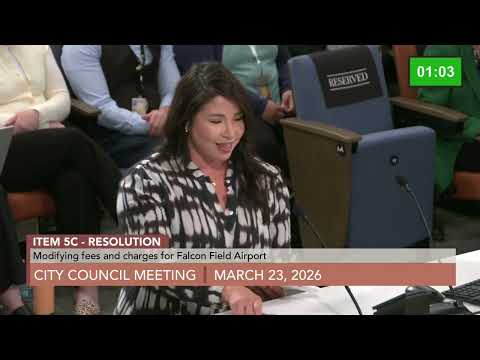
After more than two hours of public comment from pilots, flight‑school owners and residents, the Mesa City Council voted unanimously to adopt a resolution modifying fees and charges at Falcon Field to close a multi‑million‑dollar airfield funding gap and reduce reliance on general tax dollars.
Mesa — The Mesa City Council voted unanimously on March 23 to approve a resolution modifying fees and charges at Falcon Field Airport, adopting a landing‑fee structure staff says is intended to make the airportan "enterprise fund" self‑sustaining. The decision followed an extended public comment period in which pilots, flight‑school operators and area residents made competing arguments about fairness, safety and economic impact.
Supporters told council that Falcon Field has relied on one‑time land sales and deferred maintenance for years and that taxpayers should not be asked to cover ongoing runway and airfield costs. "The city cannot continue to subsidize the airport's operations," said a resident who urged the council to adopt the fees so the airport can pay for its own pavement and staffing needs.
Opponents — including flight‑school owners and instructors — warned that the proposed $20‑per‑landing charge after 10 free monthly landings would hit training operations and students hardest, reduce flight training volume and could push operations to nearby airports. "At a training airport, repeated landings are not abuse of the system. They are the system," said Chris Getz, a private pilot, describing training as the core of Falcon Field's mission and economic value.
Several pilots also warned that using ADS‑B transponder data to track landings could prompt pilots to switch off equipment or otherwise complicate air traffic monitoring; a number of speakers urged alternatives such as revisiting fuel‑flowage fees, business‑fee models, or exempting based tenants. City staff said they had evaluated multiple options, recommended a modest fuel‑flowage increase and that a landing fee was the most equitable way to address a roughly $2 million annual shortfall in the airport's airfield cost center.
Airport Director Corinne (surname not specified in the transcript) told council staff had studied comparable airports, held more than a dozen stakeholder meetings since December, and adjusted the proposal (including increasing monthly free landings from five to 10) in response to feedback. The city manager and outside counsel emphasized FAA grant assurances limit using fees for noise abatement and require fees be applied consistently across users; staff said exemptions would apply for medical and emergency flights.
Council member Go Forth framed the choice as a fiscal responsibility: the airport had exhausted a one‑time land‑sale reserve and deferred maintenance that now threatens pavement condition. Council members voiced concern about the proposal's impacts but concluded the city must act to prevent further degradation of airfield infrastructure. The council approved the resolution and fee schedule and directed staff to monitor outcomes and report back.
The measure takes effect according to the adopted schedule and staff said it will review fee impacts as new data arrives, allowing adjustments in future budget cycles. The council also discussed forming an advisory board, ongoing transparency measures and how to track impacts on flight training, but no additional formal direction was adopted at the vote.
The vote closed a contentious docket item that included detailed public testimony, several technical questions to staff about tracking, enforcement and exemptions, and repeated calls for a delay to allow an independent financial and safety assessment. Staff said the council can revisit rates after an initial implementation period and that enforcement methods would adapt if state or federal restrictions alter the use of ADS‑B for revenue collection.
The council passed the resolution unanimously. The meeting then recessed and continued with other agenda business.