Get Full Government Meeting Transcripts, Videos, & Alerts Forever!
Get email alerts on the Tax Policy topic
No spam. Unsubscribe anytime.
Professor warns high marginal tax rates and 'benefit cliffs' reduce work incentives for low‑income Minnesotans
Summary
University of St. Thomas professor John Spry said research shows large dispersion in effective marginal tax rates in Minnesota — including a cited 45.5% rate for a lowest‑20% cohort — and described program phase‑outs ('benefit cliffs') that can penalize additional work; he recommended simplifying tax and transfer structures to reduce inefficiency.
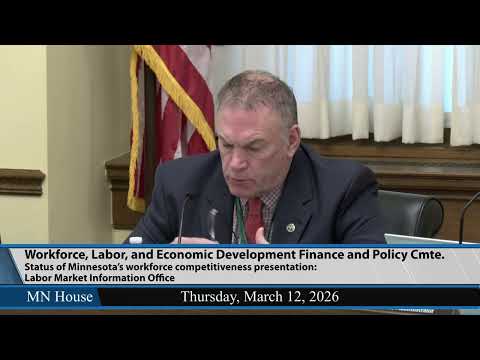
John Spry, a professor at the University of St. Thomas, told the committee that an important but overlooked constraint on labor supply in Minnesota is the effective marginal tax rate produced by layered taxes and program phase‑outs.
Spry said academic work shows some Minnesotans face effective marginal tax rates that “can approach and even exceed 50%,” and he cited a 45.5% figure for people in the bottom 20% of lifetime resources in one analysis. He described how combinations of sales, payroll and income taxes plus benefit phase‑outs create cliffs where an extra dollar of earnings yields little or no net gain for a family, discouraging work or additional hours.
“We have programs where there's a cliff — by trying to work more, you actually have fewer resources for your family,” Spry said, pointing to examples in benefit phase‑outs and higher‑education tuition thresholds that remove eligibility when incomes rise above a cutoff.
Spry said researchers estimate the deadweight loss from dispersion in marginal rates for low‑resource groups could be large in magnitude — he quoted a heuristic range (9% to 24% of labor income for the lowest group) for the labor‑income efficiency loss in some models — and suggested that a simpler, broader approach that equalized marginal rates could reduce these losses without changing total revenue.
Committee members requested Spry’s slides and further examples; Spry offered to provide the benefit‑cliff materials for follow‑up. The committee did not take formal action on his testimony.
Why it matters: Spry framed tax and transfer design as a labor‑market policy lever — changes to phase‑outs and marginal incentives could affect low‑income workers’ decisions to work, seek hours or pursue training, and therefore could factor into near‑term policy debates about taxes and benefits.