Get Full Government Meeting Transcripts, Videos, & Alerts Forever!
Get email alerts on the Large Scale Development topic
No spam. Unsubscribe anytime.
City holds informational workshop on 650-acre Virginia Smith Trust plan; advocates press for on-site affordable units
Summary
City staff and project representatives briefed the planning commission on the Virginia Smith Trust specific plan (about 650 acres south of UC Merced), highlighting phasing, sustainability goals and projected scholarship revenue; a housing advocate urged commissioners to require on-site, enforceably restricted affordable units rather than an in-lieu fee.
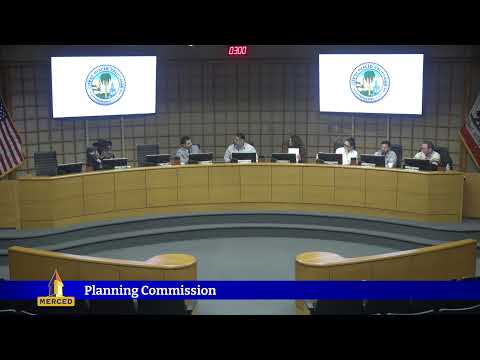
City of Merced senior planner Francisco Mendoza and project representatives briefed the Planning Commission on Dec. 17 on the Virginia Smith Trust (VST) specific plan, an approximately 650-acre mixed-use community planned south of the UC Merced campus. The session was an informational workshop; no action was requested or taken.
Mendoza reviewed the project’s long history and recent milestones, noting the site was annexed in 2024 and that early 2026 would bring several map submittals (one large-lot map and five small-lot maps) focused on Phase 1. He summarized the plan’s land-use balance—about 400 acres for residential uses, 44 acres for commercial, roughly 115 acres for parks/open space and approximately 20 acres for schools—and described sustainability projections cited in the presentation: an estimated 30% reduction in household water use relative to typical Merced households and a projected 25% reduction in vehicle miles traveled through transit-oriented design and walkability.
Mendoza and project consultant Steven Peck described phasing, infrastructure coordination, and the development agreement that frames architecture, open space and public improvements. Peck, representing the applicant team, stressed the multi-jurisdictional coordination that produced the specific plan and said the team has been working for several years to align campus- and community-scale decisions.
During the workshop, members of the public and stakeholders asked questions and provided comment. Ashley Marie Suarez, a policy advocate with Leadership Council for Justice and Accountability, urged commissioners not to accept an in-lieu fee approach that could reduce the number of enforceably restricted affordable units. Suarez cited specific-plan language and unit targets in the draft plan, saying the plan anticipates roughly 400 enforceably restricted multifamily units but that relying on a fee could result in far fewer on-site restricted units. "Recommending approval and allowing this developer to pay the in-lieu fee rather than actually moving forward with the affordable units is not the best option," Suarez told the commission.
Mendoza said staff will continue working with the applicant and other agencies and that several maps and technical attachments (the development agreement and specific plan) are posted on the city website as public documents for review. The commission did not take action at the workshop; staff indicated maps and applications would return to the commission for formal consideration in early 2026.
Next steps: staff expects the large-lot and small-lot maps for Phase 1 to come before the commission in January 2026 (timing subject to submittal), followed by community-facility financing discussions and subsequent map approvals.