Get Full Government Meeting Transcripts, Videos, & Alerts Forever!
Get email alerts on the Capital Improvements topic
No spam. Unsubscribe anytime.
Planning Commission finds 2025–26 CIP consistent with San Bruno general plan, requests more detail on large items
Summary
The San Bruno Planning Commission reviewed the draft 2025–26 Capital Improvement Program, adopted a resolution finding it consistent with the general plan under California Government Code section 65401, and pressed staff for more details on high-cost items including a $5 million technology/radio item, stormwater projects and park designs.
The San Bruno Planning Commission on May 20 reviewed the city’s proposed 2025–26 Capital Improvement Program and adopted a resolution confirming the commission’s review for consistency with the San Bruno general plan as required by California Government Code section 65401.
Assistant community development director Kelly Bagg opened the public-hearing presentation and introduced staff who outlined new and amended CIP projects. “This item before you tonight is review of the 2025–26 capital improvement program for consistency with the general plan,” Bagg said.
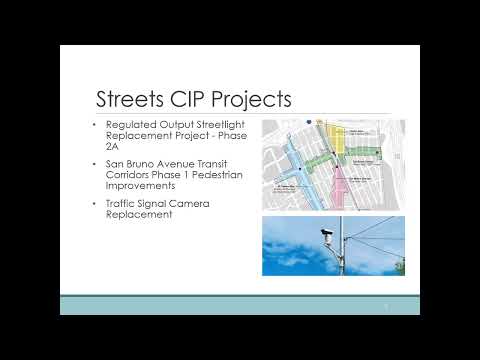
Assistant City Manager Brian Adams gave an overview of several new projects staff recommended for planning initiation, including park improvements (a dog-park concept and playground replacements), landscaping at the recreation and aquatic center, technology upgrades to improve audiovisual support for council chambers, a phased streetlight replacement, the San Bruno Avenue transit-corridors phase 1 (flashing beacons and pedestrian-safety improvements), traffic-signal camera replacements to improve signal timing, and a suite of stormwater projects including trash-capture installations and the Bennington storm-drain work.
Dina Morales, management analyst with Public Works, summarized the CIP prioritization pilot program, describing a ten-criteria, point-based framework staff adopted in January 2024. Morales said the pilot yielded 20 project nominations; of 11 projects recommended for funding, nine are located in low- or moderate-resource areas on the state opportunity-area map.
Commissioners pressed staff for more details on several large or potentially sensitive line items. A commissioner asked about “the police station radio system for $5,000,000,” noting the amount stood out on the technology list; Brian Adams said staff would obtain further detail from the police department. “We can definitely work on getting you some more information about that from PD,” Adams said.
Other questions focused on how the CIP’s “unfunded appendix” is compiled and what it represents. Staff said the unfunded appendix is a long-range inventory or replacement-cost roll-up, not a committed appropriation for the upcoming year, and that projects not selected this cycle may be carried forward as unfunded priorities for future years.
Commissioners also asked for evidence supporting specific maintenance-driven projects — for example, the Bennington storm-drain item — and questioned design-only allocations such as the dog-park design line. Staff said the dog-park item funds preliminary landscape-architect work to develop concepts and cost estimates before any construction appropriation is made.
After discussion, the commission moved and passed the staff-recommended resolution finding the CIP in conformance with the general plan; the transcript records that “the motion passes” but does not include a roll-call tally.
The commission’s recommendation will be transmitted to the city council; staff said the council will receive the planning commission recommendation later in June as part of the budget adoption process. Staff committed to follow up with commissioners to provide additional documentation and clarifications about the larger line items and project-specific details.
The record shows the commission acted on the staff recommendation but the transcript does not include vote counts or the names of movers/seconders for the resolution.