Get Full Government Meeting Transcripts, Videos, & Alerts Forever!
Get email alerts on the Performance Measures topic
No spam. Unsubscribe anytime.
Campbell council favors narrative 'service objectives' but asks for clearer targets
Summary
City staff proposed reframing Campbell's performance measures into narrative "service objectives" tied to the city mission; councilmembers generally supported the format but pressed for specific, quantifiable targets and clearer definitions for several department metrics before adoption.
Campbell City staff presented a proposal to reframe the city's performance measures as narrative "service objectives and results," and councilmembers signaled support for the approach while asking staff to preserve or add clearer, quantifiable targets where those numbers inform budget or operational decisions.
Natasha Bissell, who led the multi-year review of existing measures, told the council the goal was to remove measures that were outdated or required manual tabulation and to add plain-language context so residents understand what the city is measuring and why. "Ensure city council business is conducted transparently by providing clear, timely public hearing notices that support meaningful community awareness and participation," she said as an example of the revised language and said staff would report the 2025 on-time percentage to give residents context.
Why it matters: Council members said they value the clearer narrative but warned that removing too much quantification could weaken the measures' usefulness for budgeting and oversight. One council member said that taking out numerical targets in favor of broader statements "defeats the purpose" of measures that inform resource decisions.
Staff walked through department examples to show how the reframed measures would read and what 2025 data would be reported alongside them. Examples included measuring legal-notice timeliness for council hearings, invoice processing times for finance (for example, a historical target such as "90% of invoices processed within 45 days"), sidewalk maintenance response and completion times in public works (proposed reporting of percent completed within 15 working days), code-enforcement response and resolution timetables, counts of meals delivered by recreation programs, and public-safety record-processing timeframes (reporting percent of report requests processed within seven business days and warrants entered within three days).
Councilmembers asked for specific clarifications and additional breakdowns: counts of complaints received (not only percent responded to), the difference between volunteer hours by staff versus community volunteers, the number of applicants per posted position (to evaluate candidate pools), and whether certain measures should remain tied to the fiscal year rather than calendar reporting. Staff said that many of those numbers are tracked and that they would add clear definitions for terms such as "timely," specify fiscal-year-versus-calendar reporting where required, and return the requested 2025 data.
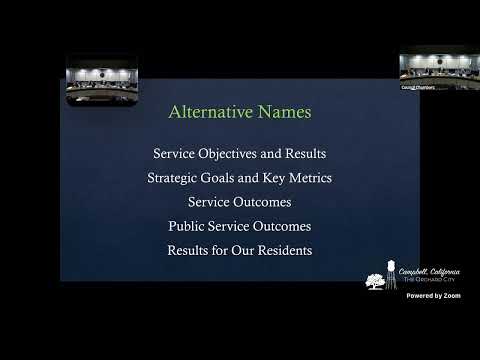
On naming, several members favored including the word "service" (for example, "service objectives and results") to emphasize the city's public-serving mission; others said the final label could be decided later after the revised document is tested with the 2025 dataset.
The chair opened the door to public comment on the study session topic and, hearing none, staff summarized the evening's direction: move toward a narrative format that pairs plain-language objectives with appropriate quantification and clearer definitions, incorporate the council's suggested additions, and present revised measures and 2025 results at the upcoming priority-setting session.
Next steps: Staff will revise the document to incorporate council feedback, flag items that must be reported on a fiscal-year basis, provide the 2025 data referenced in the presentation, and return for council review during the priority-setting process.