Get Full Government Meeting Transcripts, Videos, & Alerts Forever!
Get email alerts on the Land Use Initiative topic
No spam. Unsubscribe anytime.
San Bruno staff recommend combined land‑use, housing and economic‑development initiative after TCP feasibility study
Summary
City staff presented a study session recommending a single, citywide initiative—informed by a third‑party Transit Corridor Plan (TCP) financial feasibility assessment—to update land‑use, housing and economic‑development rules and funding mechanisms and prepare ballot measures (potentially 2026/2028) to strengthen the city’s fiscal health and attract investment.
San Bruno city staff urged the City Council to launch a citywide land‑use, housing and economic‑development initiative after a consultant’s review found the city has missed development opportunities compared with neighboring communities.
The initiative, staff said, would bundle required planning work and ballot measures so the city completes a single environmental review and public outreach process rather than multiple parallel EIRs and campaigns. City staff emphasized the proposal is intended to strengthen the city’s fiscal base: about two‑thirds of general‑fund revenue derives from taxes influenced by development, they said.
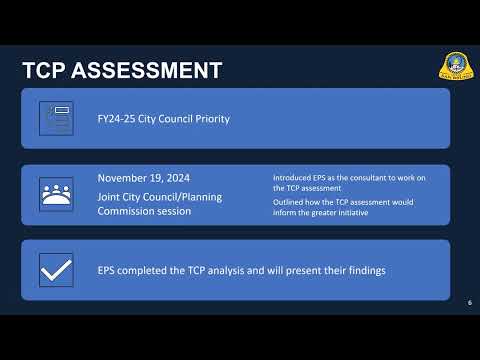
The council heard an overview of the Transit Corridor Plan financial feasibility assessment from Economic & Planning Systems (EPS). Jason Moody of EPS told the council that while San Bruno’s economy trails some neighbors in growth and job creation, newly built residential projects in the city have rents competitive with the region. The assessment found smaller, lower‑density housing types such as townhomes are generally feasible today, while higher‑density podium projects are not economically viable under current market conditions without a roughly 20–30% increase in achievable rents or reductions in costs and land prices.
Staff and EPS presented a toolbox of policy and financing measures the city could deploy to alter development economics: revise development‑impact and dedication policies, consider targeted tax or financing districts (CFDs/Mello‑Roos, EIFDs), update impact‑fee uses, permit targeted fee waivers or rebates, remove or make permanent reductions to parking minimums, relax some open‑space or FAR requirements for small parcels, and pursue public‑private partnerships for key sites. EPS identified parcel fragmentation in the TCP—about 90% of parcels under half an acre and roughly half under one‑eighth acre—as a key constraint for large podium projects.
Staff framed two ballot timelines: a broader package aimed at a 2028 ballot (to allow time for a comprehensive EIR and policy changes that would trigger ordinance 12‑84 voter requirements) and a narrower approach potentially viable in 2026 that would change the scope of ordinance 12‑84 (for example, limiting the ordinance’s automatic voter‑approval trigger to areas outside the transit corridors) so some decisions would return to the council. Staff said consultant‑led polling and community engagement (they said they would seek a firm such as Godbe Research for surveys) are immediate next steps if the council authorizes initiation.
Council members pressed for more localized data and clarified constraints. Councilmember Hamilton urged the team to use corridor‑level demographic and household data rather than only citywide averages; EPS agreed location‑specific data should guide design decisions. Councilmember Salazar asked whether airport height limits were being accounted for; staff said height diagrams would reflect Federal Aviation Administration (FAA)/airport constrains and some TCP parcels can still accommodate increased heights within noise and airport envelopes. Councilmember Alvarez asked how the initiative would affect the current 2023–2031 housing element; staff said the initiative would not hurt state compliance and would likely make the next housing element easier by having more opportunity sites identified.
A resident during public comment urged quicker voter action and opposed taller hotels, citing neighborhood character and SFO noise, and asked that private developers provide community benefits tied to large projects.
Council action: none. Staff said if council chooses to launch the initiative, a resolution would direct procurement of a consultant team and initiation of public outreach and polling, with a multi‑year engagement anticipated.
The study session materials include the EPS TCP financial feasibility assessment and related background documents; staff recommended that the council consider whether to initiate the combined initiative and authorize next steps (RFP/RFQ for consultants, engagement scope and polling).