Get Full Government Meeting Transcripts, Videos, & Alerts Forever!
Get email alerts on the Land Use Development topic
No spam. Unsubscribe anytime.
Loma Linda University Health previews 381‑unit 'University Village' project; no action taken
Summary
At a joint informational meeting, Loma Linda University Health presented plans for a six‑story, 381‑unit University Village with 10,000 sq ft of retail and roughly 706 parking spaces; the council and planning commission took no action and directed staff to proceed with CEQA and entitlement review.
Loma Linda University Health on Tuesday provided a preview of its proposed University Village mixed‑use development — a six‑story, 455,914‑square‑foot building with 381 apartments and about 10,000 square feet of ground‑floor retail — during a joint informational meeting of the Loma Linda City Council and Planning Commission.
The project team, represented by Micah Tran of 360 and Eric Schultz, vice president of campus development for Loma Linda University Health, described the site as roughly seven acres bounded by Mound Street, Prospect Avenue and Anderson Way, and said the building would include about 706 vehicular parking spaces, approximately 70,000 square feet of open space and 65,000 square feet of landscaping. The applicant is proposing code amendments to permit smaller unit and balcony minimums than the current development standards would allow.
The presentation emphasized that the session was informational only and that environmental review under the California Environmental Quality Act (CEQA), staff analysis and formal hearings will follow. "This is a duly noticed joint special meeting," the mayor said, and "no action can be taken by either body" at the session.
Eric Schultz said the housing is intended as "institutional housing" available to students, staff and others affiliated with the university, and that Loma Linda will form a joint venture with Quarry Capital to own and operate the project. "It isn't a student housing project in that it will — I just want to clarify — they aren't dorm rooms," Schultz said, adding that the apartments are market‑rate but will prioritize institutional uses.
Tobin, the project's architect, explained the 'wrap' design: a multi‑level parking garage at the center with residential units wrapping around it, stepped building profiles to respond to a roughly 20‑foot grade change between Mound and Prospect, and courtyard 'fingers' that create amenity space. The design calls for a maximum height of about 75 feet (a six‑story visual presence on Mound), with some corners eroded to a five‑story or four‑story profile to soften massing.
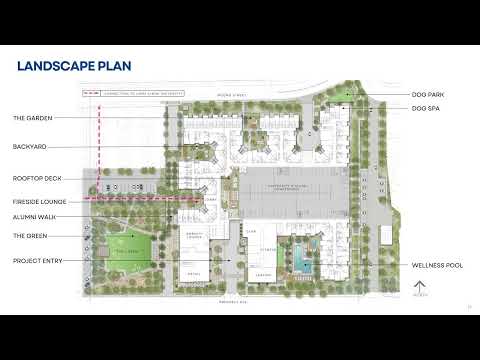
Matt Jackson of MJS Design Group described the landscape and "public realm" elements: a roughly 100‑by‑100‑foot central green for community events, an "alumni walk" with accessible ramps, publicly open walkways without gates, multiple resident courtyards, a rooftop deck and a 60‑foot lap pool. Jackson said plantings would emphasize drought‑tolerant and California‑native species.
On operational questions, the applicant said parking will be access‑controlled and sized at about 1.85 spaces per unit on average, but whether specific stalls will be assigned remains to be determined. The applicant also said chute‑fed trash rooms, on‑site compactors and dedicated property management are planned; a representative from waste hauler CR&R urged early coordination to provide compactors for recycling and organics to meet state law.
Several council and commission members pressed the applicant on traffic, pedestrian circulation and parking impacts, and one local salon owner, who said the business occupies a building slated for demolition, described the stress of impending displacement. Schultz said occupants have received courtesy notices and that the applicant expects to provide the legally required 60‑day notices when a demolition schedule is available; he added the applicant will try to assist displaced tenants in finding alternatives.
Schultz reiterated that the next formal steps are environmental review, design review, permits and continued coordination with city staff. The council and commission did not vote on any entitlement and were reminded this meeting was strictly informational; staff and the applicant said they would return to pursue CEQA clearance and formal hearings.
The city manager and planning staff said they will retain consultants for environmental review and will continue monthly coordination meetings with the applicant. The project team said they will refine the retail tenanting approach — considering either a master lease or direct leases — and will continue design and entitlements before returning for public hearings.