Get Full Government Meeting Transcripts, Videos, & Alerts Forever!
Get email alerts on the Municipal Fees topic
No spam. Unsubscribe anytime.
Fountain council approves parts of fee schedule; ambulance transport and hydrant‑meter fees increase
Summary
Council approved exhibits A–J of a comprehensive fee schedule and the water‑hydrant/non‑potable deposit section of Exhibit K, approving higher ambulance transport charges and raising certain utility deposits while setting several fee exhibits aside for more public review.
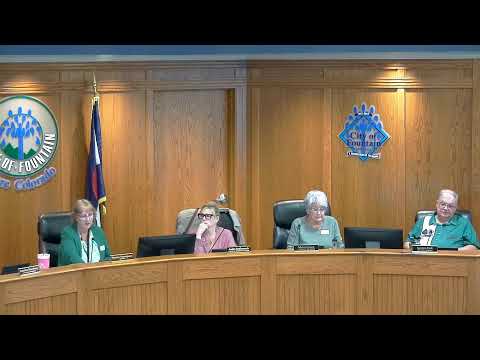
At its March 17, 2026 meeting, the Fountain City Council approved most of a packaged fee schedule — including increases to ambulance transport charges and a higher deposit for hydrant‑meter use — while setting several complex exhibits aside for further review.
The council voted to adopt exhibits A through J of Resolution 26‑017 and approved only the water‑hydrant/non‑potable deposit section of Exhibit K, instructing staff to bring the remainder of Exhibits K, L and M back for additional public review and clearer redlines. Council recorded a 6–1 vote on the package (one councilor opposed).
Fire and emergency services staff said the proposed ambulance fees bring Fountain closer to regional charge levels and help sustain the department's ambulance fund. "These proposed fees would be more impactful to those that have different health insurance coverages other than Medicaid, Medicare," the fire chief said, and outlined a new tiered schedule that includes a critical‑care transport fee. Council heard figures for the new transport pricing tiers—BLS, ALS, ALS‑2 and a critical‑care level — and a critical‑care transport fee of roughly $5,000 was discussed as the top tier for particularly resource‑intensive transports.
Councilors asked how increased transport fees would affect Medicare and Medicaid patients. The fire chief said the department is constrained by state law on balance billing: "It is against state law for us to balance bill the patients that are Medicaid patients that we transport. Typically, our recoup costs for our Medicaid patients are between $150 and $200 per transport, and we cannot, by state law, balance bill that and those patients have no co‑pays." Staff said Medicare typically covers only part of transport charges and the department will provide follow‑up information on typical Medicare reimbursement rates for the new fee schedule.
Utilities staff also presented Exhibit K, explaining a set of proposed changes to deposits and reconnection fees tied to a move to automated meter infrastructure and updated cost recovery practices. The utility director described a proposed increase in the supplemental deposit (from $350 to $500) and said the hydrant‑meter assembly costs them more than originally estimated; staff proposed raising the hydrant‑meter deposit to approximately $3,000 to cover assembly costs and losses from unreturned meters. Council asked staff to research some reconnection and supplemental‑deposit mechanics and set most of Exhibit K aside while approving only the hydrant‑meter section that evening.
Parks and recreation, municipal court, police and other routine fee exhibits (A–E, G–J) were discussed and advanced as noncontroversial; staff agreed to correct a redline discrepancy in the special‑events fee shown in Exhibit H and to return that item if necessary. Several exhibits containing significant redlines were deferred so the public could review the detailed materials before final adoption.
What happens next: staff will return the redlined exhibits (including the remainder of K, L and M) for further public review, and the city will provide additional detail on Medicare reimbursement and the practical effect of the reconnect/supplemental‑deposit changes before finalizing those items.