Get Full Government Meeting Transcripts, Videos, & Alerts Forever!
Get email alerts on the Planning And Development topic
No spam. Unsubscribe anytime.
Needles planning commission holds workshop on development entitlement and environmental review
Summary
At a March 4 workshop, City of Needles planning staff outlined the entitlement and permit-review process, emphasizing CEQA triggers, typical timelines and procedural requirements for applicants and commissioners.
On March 4, 2026, the City of Needles Planning Commission received a workshop presentation from planning staff explaining how a project moves from concept to construction and when environmental review is required.
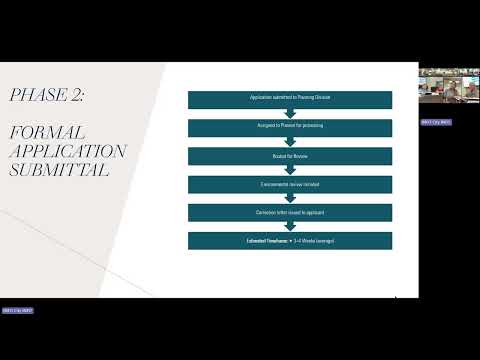
Planner Irene, who led the workshop, said the entitlement process generally follows four stages: pre-application discussion, formal application and detailed review, environmental review and entitlement approval, then plan check and construction. “This workshop is focused on understanding the city's entitlement process and the overall development timeline,” Irene said, adding that the session was intended to clarify where the Planning Commission fits in that process.
The presentation included timing and procedural details intended for applicants and commissioners. Staff described a 10-minute time limit per presentation established by Municipal Code section 2-18, public noticing requirements of at least 10 days before a hearing, and a mandatory 15-day appeal period after a decision. Irene summarized typical timelines: many entitlement applications take about one to three months at the entitlement stage while more complex environmental review can extend the schedule.
On environmental review, staff stressed that not every application triggers the California Environmental Quality Act (CEQA). As explained at the workshop, routine administrative or counter-level applications are often exempt; discretionary approvals such as conditional use permits, special use permits and tentative maps typically require environmental findings or additional studies. “Some projects may qualify for simple environmental documents, while others require more extensive studies,” the planner said, noting that initial studies and, for major impacts, environmental impact reports (EIRs) are tools used to identify and mitigate impacts.
City attorney Lena Wade reviewed meeting rules and decorum before the workshop. “No person should be allowed to speak who has not first been recognized by the chair,” Wade said, urging commissioners and members of the public to address remarks to the chair and follow recognition procedures.
During the Q&A, commissioners asked for thresholds that trigger discretionary review and whether subdivisions without immediate plans to build would require CEQA. Staff replied that the statutory definition of a project determines whether the action triggers CEQA; divisions that include construction plans or discretionary approvals are more likely to require environmental review, while lot sales without construction plans may qualify for an exemption or a notice of nonexemption.
Staff offered to distribute the workshop handout and slide deck to commissioners. The planner said she would send a copy of the materials for commissioners to keep as a reference and to share with prospective applicants.
The workshop is intended to help applicants prepare more complete applications and to give commissioners consistent context when reviewing discretionary actions. The Planning Commission did not take any legislative action as part of the workshop; it was informational.