Powhatan workshop weighs 75¢–81¢ tax scenarios as CIP, pump stations and school overruns reshape trade‑offs
Loading...
Summary
At a March 26 budget workshop, county staff presented four tax‑rate scenarios (75¢, 77¢ proposed, 79¢, 81¢) and a 10‑year CIP; supervisors debated whether to raise the rate or cut projects to preserve a 15% fund balance, prioritized wastewater pump stations to enable development, and challenged estimates for a $7.8M Pocahontas Elementary HVAC project that may require additional borrowing.
Powhatan County officials on March 26 spent several hours testing tax‑rate scenarios against a proposed 10‑year capital improvement program and discussing which projects to fund, defer or reprice.
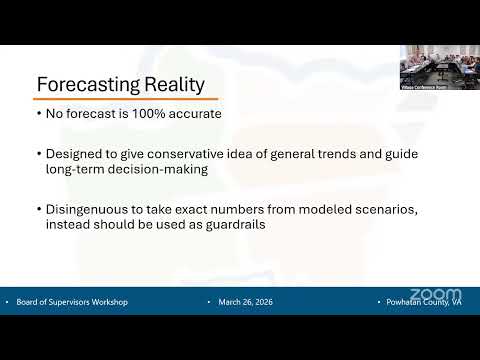
Mister Morris (S7), the staff analyst who ran the county’s financial model, presented four scenarios — 75¢, 77¢ (the current proposal), 79¢ and 81¢ — holding a set of baseline assumptions (3% wage and operating growth, 7% benefits growth, 3.5% annual assessment growth and full funding of the proposed CIP as modeled). "We’re gonna have 4 scenarios... 75¢, 77¢, 79¢ and 81¢," Morris said, and warned the projections assume the CIP projects remain as currently listed.
Staff highlighted the trade-offs these scenarios create: under a 75¢ scenario the model shows fund‑balance pressure in the early 2030s if every CIP project is funded; an 81¢ rate, the staff said, would preserve the county’s modeled guardrails for the full 10‑year horizon but would commit taxpayers to a higher, long‑term rate.
Several supervisors pressed staff on the CIP assumptions and forward‑looking estimates. One supervisor (Committee member (S1)) raised concerns about inflation and phasing, asking how the model accounts for projects that are designed now but built years later. Mister Morris said the CIP entries reflect the departments’ current project estimates and that staff can re‑run models with alternate inflation or phasing assumptions.
Utilities and pump stations emerged as a priority and a potential choke point for economic development: staff said the county’s force main and lack of regional pump stations limit new connections and that building public pump stations sooner would enable commercial and industrial development. "If we were to prioritize those projects... we would need an accompanying tax rate increase to be able to do that," Presenter (S6) said, and staff agreed to model scenarios that accelerate A&E and construction for pump‑station work.
The workshop also featured a fractious exchange over Pocahontas Elementary School’s HVAC replacement. Schools’ projects appeared in the CIP as a $7.8M bonded item; several supervisors pressed why prior borrowings and phasing had not resulted in completed phases and questioned procurement and estimation practices after contractors’ bids exceeded earlier forecasts. "That system there over 2 summers is going to cost $14,000,000," said Committee member (S1) summarizing a staff estimate of the full two‑summer replacement cost, a figure that prompted cross talk about engineering, phasing and contingency.
Staff explained the procurement constraints of the Virginia Procurement Act and the practical difficulty contractors face accepting phased awards without commitment on later phases. Staff said if the board budgeted and appropriated a project amount now, the county would be able to fund A&E and move toward design and bidding, but actual construction bids would come later and could be above or below the forecast.
On other CIP lines, the board debated a $175,000 Parks & Recreation office renovation contained in the PLC renovation item; some supervisors favored removal from FY27 pending feasibility and ownership clarification, while others argued delaying could inflate future costs. The board agreed to remove the PLC renovation from the FY27 proposed CIP and shift a placeholder feasibility study to FY28.
The library outreach van drew consensus: staff recommended moving a $70,000 FY28 appropriation into FY27 to purchase a smaller outreach van rather than a full bookmobile, enabling grant opportunities for outfitting and outreach.
The board also discussed outside‑agency funding: staff proposed adding a $10,000 SPAN Center request (staff said SPAN submitted on time but was inadvertently missed in processing) and considered, but did not adopt, making an exception for a late YMCA letter; supervisors disagreed about making ad‑hoc exceptions to a new application scoring process. The board signaled it would include SPAN’s request but not the YMCA request pending a completed application.
On fees, the board agreed to advertise a revised Agricultural and Forestal District (AFD) application advertising fee of $200 per application (reduced from an earlier $500 figure discussed), subject to the formal advertisement and hearing process.
Staff summarized the workshop trade‑offs and said they would balance the final proposed budget book for advertisement: the county’s proposed budget would be advertised with a 77¢ rate while staff would model and present a schools transfer consistent with a separate 75¢ allocation framework. Supervisors asked staff for follow‑up modeling to show the revenue and debt impacts of accelerating key CIP projects, particularly pump stations and urgent school projects.
The workshop closed with a public comment from resident Ranjit Mazumdar, who asked whether the county has the people and other resources to implement the CIP as shown and urged joint County–School discussions on FY28 priorities given growing tax burdens for residents.