Get Full Government Meeting Transcripts, Videos, & Alerts Forever!
Get email alerts on the Fire Hazard Map topic
No spam. Unsubscribe anytime.
Council tables vote on CAL FIRE hazard map after insurance and legal concerns raised
Summary
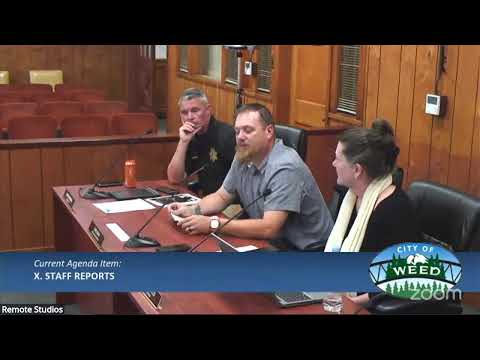
Weed City Council moved to table a second‑reading ordinance adopting the state‑recommended local fire hazard severity map after members voiced concerns about mapping methods and insurance impacts; city attorney said failing to adopt could prompt a writ of mandate but monetary penalties were not identified.
The Weed City Council tabled a second‑reading ordinance to adopt updated local fire hazard severity zones after a council member said the map appears flawed and could harm residents by prompting higher insurance costs or insurers to decline coverage.
Council member (S4) challenged the map’s designation, saying the Mill Fire was being counted among wildfire events and arguing that labeling the city as extreme hazard could push properties into the California FAIR Plan. “I am highly concerned that the Mill Fire is 1 of the things that’s being considered in designating the way that they’ve designated within the city of Weed,” S4 said. “I think we would be doing a disservice to the people of the city … and allowing insurance companies to rely on that.”
City Attorney Ruderman (S5) warned the council that state law requires cities to adopt updated local hazard maps and that the most likely legal consequence of not adopting would be a writ of mandate in superior court seeking to compel the city to perform the statutory duty. “Someone could bring a writ of mandate … to compel the city to perform a mandatory duty that the state has set for the city,” Ruderman said, noting the city could be responsible for the petitioner’s attorney fees.
Assistant Chief Carter (S8) told the council staff believed the grant the city received for mitigation work did not require adopting the new map and said he would review grant documentation to confirm. “As far as I know, there’s nothing in the grant that says you must accept the updated fire hazard severity map to receive funding,” S8 said.
After extended discussion about whether other jurisdictions have seen negative consequences from adopting similar maps and requests for staff to research Oregon’s experience, the council made and seconded a motion to table the ordinance and directed staff to gather information from other local jurisdictions and clarify grant and insurance implications. The motion carried by voice vote; a roll‑call tally was not recorded in the transcript.
Next steps recorded in the meeting: staff were asked to report back with (1) what neighboring jurisdictions have done, (2) whether adoption correlated with insurance rate changes or insurer refusals, and (3) any grant or statutory deadlines the council must meet. The item will return to a future meeting for further action.