Get Full Government Meeting Transcripts, Videos, & Alerts Forever!
Get email alerts on the Zoning Temporary Structures topic
No spam. Unsubscribe anytime.
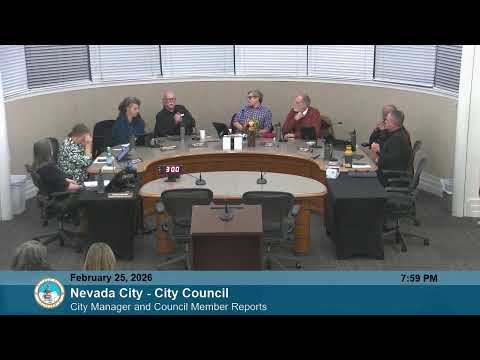
Nevada City Council directs staff to draft clearer rules for temporary construction structures and living units
Summary
Council asked staff to prepare ordinance amendments to allow on-site storage containers by ministerial permit with strict time and screening standards and to draft rules for temporary RV/mobile-home occupancy tied to building permits; public commenters urged short time limits and safeguards for neighborhoods and small businesses.
Nevada City Council on Feb. 25 directed staff to prepare ordinance amendments that would change how temporary storage containers and temporary residential occupancy (RVs, mobile homes) are handled during construction.
Interim city planner Jessica Hankins told the council that the city’s current zoning code treats storage containers on construction sites as a discretionary conditional‑use permit, a process she said is costly (currently cited in the staff memo as roughly $2,405) and time‑consuming. Hankins recommended converting that review to a ministerial process with clear performance standards — for example, proof of an active building permit, a defined removal timeline, screening and shielding requirements, size limits and setbacks — so applicants could receive faster, predictable approvals rather than a discretionary, case‑by‑case determination.
Hankins also asked whether the council wanted the city to regulate temporary occupancy — people living in RVs or tiny homes on sites with active permits — noting that the zoning code currently does not address that use. She recommended a separate set of performance and health/safety standards for temporary occupancy, including sewer, water and electrical hookup requirements and tie‑ins to building‑permit timelines.
Councilmembers pressed for firm limits. One member asked for an ‘absolute and precise’ time limit if the city adopts a ministerial path; Hankins said the ordinance could set a fixed example (six months with a possible six‑month extension tied to demonstration of active construction) or tie the allowance to the building permit’s lifecycle. Several members emphasized the need for an enforcement pathway so the city can remove or revoke temporary uses that become de facto permanent.
Public commenters echoed those concerns. Business owners and residents urged short time limits to avoid storage containers or long‑term parking replacing needed parking or creating neighborhood impacts. Harry Bennett, who described building a house under an active county building permit, encouraged the council to consider parity with county practices that allow temporary living units tied to an active permit. A resident described persistent speeding on a nearby street and asked the city to focus enforcement resources where safety issues are occurring.
What happens next: Staff will draft ordinance language and performance standards, route it through the planning commission for review, incorporate public input and return to council for formal readings and potential amendments. Any fee changes, specific timeline durations and enforcement protocols will be included in the proposed ordinance for council approval.
Authorities and legal context cited in the meeting included California Government Code section 54954.3 (public comment rules) and local zoning code provisions on conditional‑use permits; proposed changes would be administrative adjustments to permitting process and local ordinance text.