Get Full Government Meeting Transcripts, Videos, & Alerts Forever!
Get email alerts on the Heritage Trees topic
No spam. Unsubscribe anytime.
Menlo Park EQC leaves staff approval intact for removal of 13 heritage trees at 68 Willow Road
Summary
After staff, applicant and appellant presentations and public comment, the Menlo Park Environmental Quality Commission failed to reach the four affirmative votes needed to reverse staff's approval; the city arborist's permit to remove 13 heritage trees at 68 Willow Road remains in place. (Mitigation and appeals to planning commission discussed.)
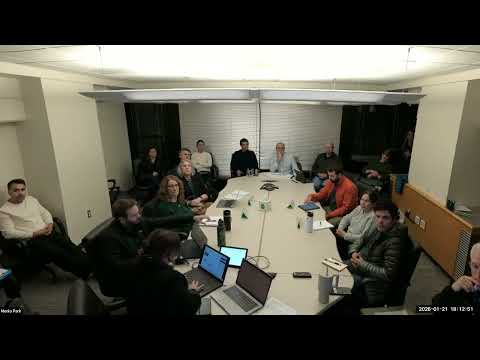
The Menlo Park Environmental Quality Commission on Wednesday heard a challenge to staff's approval of a permit allowing removal of heritage trees at 68 Willow Road and, after two closely contested motions and public testimony, left the staff decision in place.
City arborist Jillian Keller told commissioners the permit review followed the city's checklist (application, arborist report, construction plans, mitigation plan and an alternative design and cost analysis). Keller said mitigation for the set of heritage trees was based on appraised values and that the sum of those appraised values is "about $472,000," with approximately $422,000 remaining as an in-lieu fee if on-site replacement cannot fully offset the loss. Keller described the city's financial infeasibility test for alternate designs: if an alternate design costs more than 140% of a tree's appraised value, preservation can be deemed financially infeasible.
The proposed redevelopment is a 50-unit townhome project, the applicant team said. Jeff Potts of SDG Architects described site constraints — fire access, underground utilities, required bioretention basins and the riparian buffer — and said the design prioritizes saving trees in the creek corridor while locating necessary infrastructure and building footprints elsewhere.
Appellant Richard Chrome, a Menlo Park resident who filed the appeal, told the commission he supports housing but urged more rigorous, consistent alternative-design analyses. Chrome identified three trees (numbers 28, 44 and 45 in project materials) as candidates for additional preservation measures and urged consideration of strategies such as tunneling for utilities, structural soil, ramping or hand‑digging to protect roots. "I think the onus and the burden should be on the applicants in these instances," he said, arguing the city and developers should more thoroughly evaluate preservation options before approving removals.
Two members of the public echoed those concerns. Rebecca Eisenberg, introduced as a director on the Santa Clara Valley Water District but speaking in her personal capacity, described mature trees as irreplaceable and urged the commission to weigh long-term ecological harms. Another commenter urged consistency in how rules apply to residents and developers.
Commissioners asked detailed clarifying questions about how many trees were involved (staff and the appellant said 23 trees were proposed for removal, 14 were initially appealed, one appeal had been resolved, leaving 13 in the current appeal) and whether the hearing should focus on three trees singled out by the appellant. Keller and the applicant explained technical constraints near sidewalks, a gravity-fed storm drain line and required foundation preparation that extend beyond building footprints and limit options for retaining certain large trees.
The city attorney advised the commission that state housing laws, including provisions tied to density bonuses and the Housing Accountability Act, limit the commission's ability to deny or impose conditions that would materially increase project costs or reduce density without making specific findings. Staff said the EQC may ask the applicant to consider voluntary design changes but cannot unilaterally require changes that conflict with applicable state objective standards without additional financial evidence.
After deliberation, Commissioner Kissel moved, and Vice Chair Meyer seconded, to deny the appeal and uphold staff's decision to approve the permit. The first vote was conducted by hand; staff reported three "aye" votes, three abstentions and one recusal. City staff consulted the city clerk and advised that the motion had failed because four affirmative votes are required. Commissioner Headley then moved (seconded by Commissioner Hernandez) to approve the appeal and deny staff's decision; that roll-call result was a 3–3 split. With a tie and the earlier failed motion, the meeting record shows the staff decision stands: the appeal failed and the permit approval for removal of 13 Menlo Park heritage trees at 68 Willow Road remains in place.
The commission discussed next steps: an EQC decision may be appealed to the planning commission and ultimately to the city council, and actual tree removals would not proceed until project approvals and construction permits are in place. Commissioners also discussed nonbinding options—asking the applicant to voluntarily consider design adjustments, or using mitigation funds to investigate transplanting or other preservation techniques—while noting such options are subject to the applicant's agreement and to state housing law constraints.
What's next: the project will proceed through subsequent planning review steps; any applicant concessions or further appeals would come as part of those processes. The EQC asked staff to include discussion notes in the planning record so later reviewers will see the commission's concerns about canopy loss and alternatives considered.