Get Full Government Meeting Transcripts, Videos, & Alerts Forever!
Get email alerts on the Campground Project topic
No spam. Unsubscribe anytime.
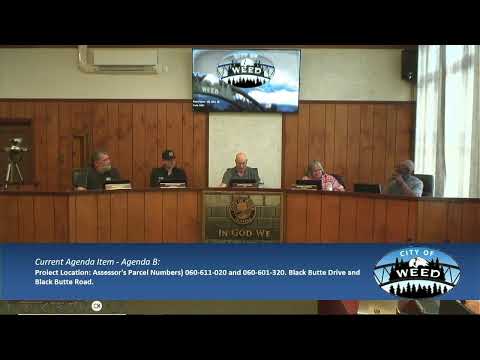
Weed planners approve 157‑acre Base Camp Mount Shasta campground over public objections (3–2)
Summary
After extensive public comment alleging gaps in the IS/MND on wildfire risk, biological impacts and tribal consultation, the planning commission voted 3–2 to certify the initial study and mitigated negative declaration and approve a conditional use permit for a 157‑acre campground by Base Camp Parks LLC.
The Weed City Planning Commission certified an initial study and mitigated negative declaration and approved a conditional use permit for the Base Camp Mount Shasta campground on a 157‑acre parcel, voting 3–2 after more than an hour of public comment and discussion about wildfire risk, sewage and biological resources.
The project, proposed by Base Camp Parks LLC, would create about 95 campsites with a mix of partial hookups and off‑grid sites, cabins and rental "pods," walking trails and other amenities. "We think it’ll be a fantastic project if we can make it happen," Clayton Snyder, cofounder and CEO of Base Camp Parks LLC, told commissioners.
Multiple public speakers and experts urged a fuller environmental review. Bruce Shoemaker, an adjacent landowner, said he received late notice and raised concerns about wind‑driven wildfire behavior, campfire risk, and the adequacy and permanence of railroad emergency access. "I'd like to see that that was in writing as a permanent easement and not just some informal agreement," Shoemaker said.
Andrea Clawson, a conservation biologist who said she prepares CEQA documents professionally, said the IS/MND was superficial in several technical areas: notice timing, inadequate biological review for special‑status species and monarch habitat, insufficient archaeological buffers, and a lack of landscape or mitigation plans. "This document just really doesn't consider a lot of things that they should have," Clawson said.
Geneva Oman, representing a local nonprofit, urged the commission to require a full environmental impact report (EIR), citing single‑lane railroad egress, loss of trees without a replanting plan and inadequate protection for nesting birds. Oman said evacuation time in fire scenarios is a serious concern and that the IS/MND understates those risks.
Staff acknowledged drafting errors in the packet (including an incorrect jurisdiction reference to Riverside) and said the IS/MND was prepared by the applicant's consultant and circulated as requested. Mark Teague, the city planner, said emergency access through the railroad right‑of‑way will be improved and controlled by the fire and police departments. "The access for that and the gate for that will be controlled by the fire department, the police department, not by the applicant," Teague said.
Commission debate focused on whether the interim use of engineered septic and other interim measures was acceptable until city sewer could be extended, the adequacy of fire‑safety analysis and the level of biological and tribal cultural‑resource review. The commission voted to certify the IS/MND and adopt CEQA findings and approvals for the project. A roll call recorded Commissioners Palmer, Dewhurst and Chair Nicholas voting yes; Commissioners Rivera and Thomas voting no.
The planning department said two options are being evaluated to extend sewer capacity: a USDA loan route that could start construction in 2027, or waiting for state funding that could permit construction on a longer timeline (staff estimated 2031 if reliant on state funds). Staff and the applicant will incorporate conditions required by the commission as the project moves toward permits.