Get Full Government Meeting Transcripts, Videos, & Alerts Forever!
Get email alerts on the Transportation Metrics topic
No spam. Unsubscribe anytime.
Teaspoon subcommittee proposes KPIs to cut collisions and expand Burlingame bike network
Summary
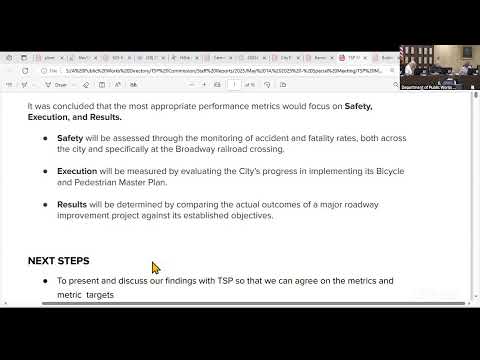
Vice Chair Kouchi presented a draft Teaspoon subcommittee report proposing measurable KPIs for safety, execution and results: a recommended 25—35% reduction in five-year averages for collision categories over three years, a zero-fatality safety goal, and multi-mile targets to increase bike-plan implementation and low-stress routes.
Vice Chair Kouchi presented the Teaspoon subcommittee's draft key performance indicators for Burlingame transportation on a three-part framework: safety, execution and results. The draft uses city and external data to propose specific, time-bound targets and recommends feeding the metrics into the city's Vision Zero work and to City Council for adoption.
"The goal of the subcommittee is to provide a set of potential goals or targets with measurable metrics to be used by Teaspoon," Kouchi said, explaining the group analyzed Transportation Injury Mapping System data for 2018—2024 and separate Broadway grade-crossing reports. He emphasized the subcommittee's intent to present a single-number target once members and staff agree on metric definitions.
On safety, the subcommittee recommended setting targets by comparing highs and lows and recent trends and proposed "achieving something between 25—35% reduction in the five-year average of each category over the next three years," with a stated fatality goal of zero. Kouchi noted that the zero-fatality objective aligns with Vision Zero principles but said the committee was cautious about how to phrase a specific reduction percentage for fatalities.
Commissioners and staff discussed the Broadway railroad crossing as a priority example. Staff noted the city shares data with Caltrain and the San Mateo County Transportation Authority and said Burlingame is high on the list for Section 190 grade-separation funding. Staff also described near-term steps (pavement restriping, additional signs, reflectors and systems Caltrain has piloted) that could reduce collisions prior to a grade separation.
On execution, the subcommittee recommended measurable progress on the bike-ped master plan. For the commuter route (10 miles total), the report found about 1.2 miles implemented as planned (12%), 5.1 miles of signage (50%) and 1.4 miles (14%) at stress-level-1 (the low-stress conditions targeted at the "interested but concerned" rider group). The subcommittee recommended adding 6 miles of plan-aligned infrastructure over three years to reach roughly 7.2 of the 10 miles.
Commissioner Brown reviewed the recreational/Bay Trail findings: the Bay Trail route is about 9.6 miles in scope, with roughly 5.7 miles (59%) already meeting plan accommodations. The subcommittee proposed adding approximately 2 miles to increase low-stress accommodations and acknowledged that cross-jurisdictional connections (Peninsula Avenue, Millbrae Avenue, North—1South links) will require coordination with neighboring cities and agencies.
For results, Kouchi proposed using a completed major project at least a year old to assess outcomes; the California Road Diet was cited as a case where city staff could compare pre- and post-improvement collision and speed data and report back to the commission.
Several commissioners urged the subcommittee to tidy the draft (including correcting minor data typos flagged during the meeting), share the supporting spreadsheets with Vision Zero and city staff, and then present a single, council-ready target. Commissioner Johnson, participating remotely, said the work should be integrated with Vision Zero to give the metrics a clear home and community visibility.
Kouchi said the next steps include meeting with staff (Syed) and the mayor, refining the draft and the spreadsheet, adding a subcommittee member to share workload, and preparing a presentation for City Council. The commission took no formal vote on the report at the meeting; Chair Martos adjourned the session after concluding discussion.
The commission agreed to circulate the subcommittee's spreadsheet and a cleaned-up draft in advance of follow-up meetings with Vision Zero stakeholders and the mayor.