Get Full Government Meeting Transcripts, Videos, & Alerts Forever!
Get email alerts on the Intersection Safety topic
No spam. Unsubscribe anytime.
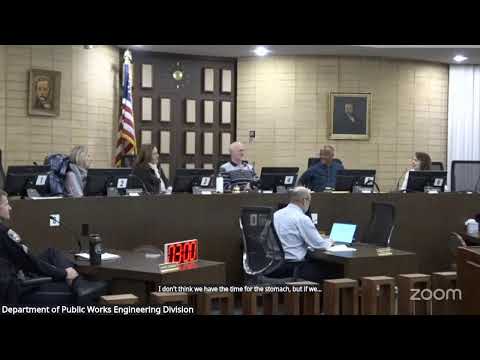
Commission approves protected‑left signals at Peninsula/Dwight/Delaware; bulb‑out decision deferred
Summary
The Burlingame Traffic Safety Commission voted unanimously to change signal timing to protected left turns at the Peninsula/Dwight/Delaware intersection to reduce pedestrian and vehicle conflicts, while deferring a final decision on curb bulb‑outs after residents urged preserving a decorative wall.
The Burlingame Traffic Safety Commission on a 5–0 roll‑call vote approved changing the Peninsula/Dwight/Delaware intersection to protected left‑turn signal phasing to reduce pedestrian and vehicle conflicts.
Chair Martos said the commission’s action will allow San Mateo — which operates the signal — to proceed with design and advertising for construction without delay. Commissioner Brown made the motion to adopt Signal Option 3, which was recorded as passing unanimously.
The staff presentation, given by Mr. Wong, said an 11‑year collision review at the intersection showed five pedestrian collisions, including one fatality, and six vehicle collisions, several of them broadside crashes. Staff recommended protected lefts for all approaches because the phasing would create "don't walk" phases that remove pedestrian conflicts with turning vehicles. Mr. Wong told commissioners that San Mateo and Burlingame have coordinated outreach — including an online survey and community meetings — and that the survey showed strong community support for pedestrian safety measures.
The meeting also included detailed discussion of three bulb‑out design alternatives for the Burlingame (north) corner. Staff described: Option 1 (replace the existing landscape island and relocate wall features into a new bulb‑out), Option 2 (a smaller retrofit that preserves the island but creates a small recessed triangular area), and Option 3 (a full build‑out that preserves the existing wall but narrows the travel lane to about 10 feet). Staff noted Option 1 was a preferred clean‑slate design and that both agencies had recommended that approach; staff nonetheless recognized strong local attachment to the existing wall.
Several residents urged preserving the wall where it marks the entrance to the neighborhood. Lynn Feeney, who said she helped design the original wall and lives at 15 Dwight Road, told the commission the wall "signals that this is a residential area" and that the current bulb‑outs "have worked." Peter Gorski, a Dwight Road resident, asked the commission to reuse tiles and signage if a new configuration is selected and criticized staff over how the neighborhood’s collector streets were described during prior outreach.
Commission debate centered on trade‑offs: commissioners and staff agreed the traffic signal changes were urgent given the collision history, but they were split on whether the bulb‑out that preserves the wall would create tight turning radii that could delay emergency vehicles or delivery trucks. Mr. Wong said truck‑turn templates showed large vehicles would need to "roll over" the centerline in some scenarios and that a 10‑foot lane would require moving the stop bar farther back than drivers expect, which could affect driver behavior at the approach.
After an initial motion for Bulb‑Out Option 1 failed for lack of a second, the commission took a separate motion on Option 3; that motion failed to attract a majority (the roll call included abstentions and at least one opposing vote). Instead of forcing a final choice that night, commissioners approved the signal phasing immediately and directed staff to return quickly with revised bulb‑out alternatives that seek to preserve wall elements (for example, by reusing tiles or relocating signage) and to coordinate further with San Mateo. Chair Martos asked staff to try to return with a revised design "soon" so the bulb‑out decision does not delay the signal work.
Next steps: San Mateo will continue signal design so construction advertising can proceed; Burlingame staff will work with their San Mateo counterparts to produce bulb‑out refinements and present them to the commission at an upcoming meeting.
Quote: "We want to get the traffic signal moving," Chair Martos said, while asking staff to "see if we can preserve some of the components" of the wall before making a final bulb‑out selection.
Outcome: Signal Option 3 approved (5–0). No bulb‑out option adopted; commission requested revised designs and additional community input.