Get Full Government Meeting Transcripts, Videos, & Alerts Forever!
Get email alerts on the Housing Policy topic
No spam. Unsubscribe anytime.
San Bruno staff outlines TOC housing-policy options, eviction-reporting concerns and long-range economic strategy
Summary
Staff presented a package of housing production and protection policies to meet TOC (tier 6) compliance, including condo-conversion limits, tenant-relocation pay, and a debated eviction-notice reporting requirement; staff warned the city lacks enforcement capacity and outlined a multiyear outreach, EIR and consultant plan leading to public hearings this fall.
San Bruno staff on Wednesday outlined a suite of housing production, protection and preservation policies the city would need to adopt to meet Transit-Oriented Communities (TOC) tier-6 compliance, and described a parallel economic-development initiative intended to attract private investment.
The presentation, delivered by a city staff member, said the city must adopt at least two policies in each of three categories—production, regulation and protection—to satisfy the housing-element requirement tied to TOC. The staff member said the first public hearings are scheduled for September with a tentative City Council hearing in October.
"We're both on meeting the minimum requirements of tier 6 compliance, in order to maintain eligibility for regional transportation funding," the staff member said, framing the timeline and the need to align local ordinance language with state/regional requirements.
Key policy proposals included: codifying development-certainty provisions without a sunset to secure long-term credit for production policy #7; a condo-conversion restriction that would require 1-for-1 replacement of rental units unless 90% of converted units are purchased by existing occupants or all converted units are restricted as affordable; and tenant-relocation protections that staff described as providing at least three months' rent for some no-cause displacements.
On condo conversions, staff said: "To be clear, common conversions are about putting an existing rental building and turning them into condo," and noted the TOC policy permits exceptions when current occupants purchase units or when converted units remain affordable.
Staff also raised a key operational concern about eviction-notice reporting. The presentation warned that some TOC language would require property owners to file eviction notices with the city, and staff said the city does not have enforcement staffing to receive and act on a steady stream of filings. "Staff is concerned that having a regulation that required us to take the notice ... implies that we do something about it," the staff member said, noting that an unfunded reporting requirement could create expectations the city cannot meet.
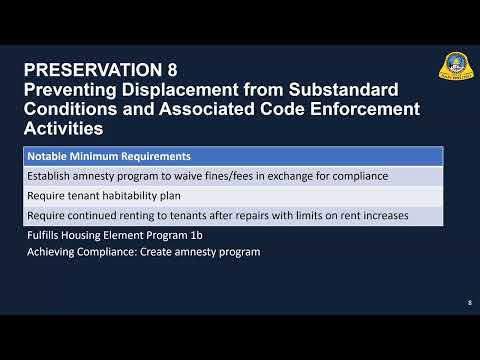
On displacement prevention, staff recommended pursuing a financing or fee-waiver program that would help owners make repairs while preserving tenants' ability to return and limiting post-repair rent increases; the alternative would be a grant or loan program targeted at specific neighborhoods, which staff said could be more limited in reach.
The presentation tied housing changes to a broader economic-development strategy intended to increase retail and business tax revenue by allowing more housing and height in targeted areas, adjusting FAR and parking requirements, and offering temporary waivers or targeted incentives. Staff said consultants will be hired via RFP and that they expect two years of public engagement, an environmental impact report (EIR) for general-plan changes, and community surveys this fall. A staff update noted a related public comment period closed Aug. 11 with about 15 attendees and that a new senior manager will start in September.
A committee member interjected on technical timing for the EIR and implementation sequencing, and staff reiterated that some parts of the initiative could be phased to seek earlier action where legally possible while other regulatory changes must wait for environmental review.
The presentation emphasized fiscal trade-offs: new development can increase sales and business tax revenue but also raises service costs; staff said the city has budgeted a maintenance fee and some staff positions to support the initiative but warned against adopting unfunded enforcement obligations.
Next steps the staff outlined include returning to the commission with ordinance language in September, conducting community engagement and consultant-led analysis, preparing required environmental review, and bringing measures to the City Council for consideration this fall.
The presentation and Q&A did not include any formal votes or final decisions; commissioners asked clarifying questions and staff said it would return with draft ordinance language for further review.