Get Full Government Meeting Transcripts, Videos, & Alerts Forever!
Get email alerts on the General Plan topic
No spam. Unsubscribe anytime.
Merced advisory group hears community priorities on safety, transit, downtown and housing as general-plan update wraps existing-conditions phase
Summary
At a March meeting, Merced's Citizens Advisory Focus Group reviewed the finalized existing-conditions workbook and heard community input on pedestrian and bike safety, transit service, downtown investment and housing; staff said the online survey is open through March 16 and offered no new high-speed-rail direction.
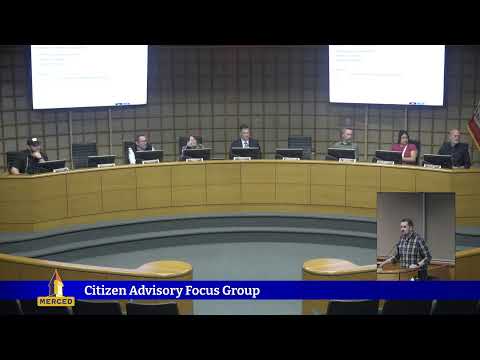
Merced's Citizens Advisory Focus Group met in March to conclude the existing-conditions phase of the city's general-plan update and to collect focused feedback from members and the public on issues, assets and opportunities to shape the plan's vision.
Brent, a consultant on the project, told the group the existing-conditions and trends workbook has been finalized and posted online. He said that document will serve as the baseline for the environmental-impact report later in the process and be used to draft the plan's vision and guiding principles.
Planning Manager Sam gave the group a brief status update on high-speed rail and said bluntly: "I have no update." He and consultants told members the High-Speed Rail Authority has not provided a firm direction on station decisions and that the city has not received any new, actionable guidance while state-level legislative activity continues.
Hannah Woolsey, the consultant lead planner, summarized the January 28 community workshop. She said the four-hour event drew more than 50 sign-ins and offered materials and activities in English, Hmong and Spanish. "People were very engaged," she said, and staff have mirrored those workshop activities in an online survey that will remain open through March 16.
CFAG members then discussed issues raised at the workshop and in their districts. Curtis Thomas, the Bicycle Commission representative, urged safer, separated bicycle infrastructure and changes to freight routing on West Childs Avenue. He said, "If we just turned all the low-density R-1 zoning to medium density, we could house 234,000 people without growing the city limits by one acre," a capacity estimate he described as rough, "napkin math."
District concerns included aging downtown infrastructure and public safety. Cynthia Kelly, representing District 3, cited recent homicides and said the city needed to consider rapid-response policing and the possibility of substations: "We've had 3, 4, 5 homicides since January 1'and one today at Applegate Park while the children were there after school."
Members emphasized transit and neighborhood services as planning priorities. Several speakers advocated reworking bus service toward a grid network for more frequent, predictable routes, improving sidewalks and curb ramps, and encouraging smaller, neighborhood-scale retail to reduce car trips and support local businesses.
Participants also highlighted downtown and UC Merced as major assets. Multiple members recommended leveraging the university and new cultural-district designation downtown to foster entrepreneurship, tourism and affordable housing near activity centers. One member pointed to Assembly Bill 812 as a potential tool to reserve affordable units for artists near the new cultural district.
On opportunities, members suggested activating Bob Hart Square with public events, exploring a teaching-hospital partnership to expand heart-attack interventions, and reconsidering parking minimums to promote walkable, mixed-use neighborhoods.
Consultants said they will synthesize the CFAG feedback and community survey responses into a draft vision and guiding principles, circulate materials to members in advance of the next meeting and return later in the year to work through the policy elements. The meeting adjourned at 7:59 p.m.
What happens next: the online survey that mirrors the workshop activities remains open through March 16; consultants plan to present a draft vision and guiding principles back to the CFAG before those materials go out for broader public review.