Get Full Government Meeting Transcripts, Videos, & Alerts Forever!
Get email alerts on the Cdbg Home Reallocation topic
No spam. Unsubscribe anytime.
Compton council opens hearing to reallocate roughly $7.5M in federal housing and community funds and approves Clean Team jobs program
Summary
Council members heard a staff plan to move about $7.5 million in prior-year CDBG and HOME balances into ready-to-launch projects including park upgrades, fire station restrooms, VFW repairs and housing rehab; the council approved a CDBG-funded Clean Team to employ about 10 residents.
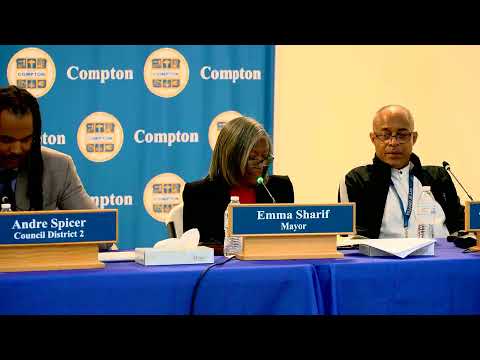
Compton City Council on Nov. 18 opened a public hearing on a substantial amendment to reallocate prior-year community development block grant (CDBG) and HOME funds and approved a separate CDBG-funded Clean Team employment training program.
Grants staff presented a proposal to move roughly $7.5 million in unused prior-year federal balances into projects the city calls "ready to launch." "We're looking to reallocate roughly 7 and a half million dollars, $3,664,647.84 in CDBG funds ... also, HOME funds, $3,000,905.07," presenter Jamelle Woods told the council. Recommended CDBG projects include the Greenleaf Parkway upgrades (exercise equipment replacement and overhead canopies at multiple sites), public-facility restroom facelifts at city hall and four fire stations and facade work for local buildings including the VFW.
Woods said the HOME recommendations include a two-year tenant-based rental assistance (TBRA) program and a senior-targeted housing rehabilitation program. On TBRA he summarized the basic benefit: the program would pay three to six months of back rent or utilities where eligible, and "if the city pays back rent, then the funding goes directly to the landlord, not to the tenant." Staff also said a two-year TBRA program would require the city to allocate at least 15% of HOME funds to a CHDO (Community Housing Development Organization).
Council members focused on likelihood of completion and long-term maintenance. Several residents and councilmembers urged that maintenance follow investment — for example, speakers pressed that Greenleaf Parkway and parks like Ellerman and Kelly need ongoing upkeep. On program mechanics, staff clarified a technical but important difference: CDBG-funded rehab can be targeted (for example, roof replacements), while HOME-funded rehab "the minute that we touch that home, if there's any other deficiency, we must address it," Woods said, meaning HOME-funded rehabilitation may trigger more extensive work.
Council also discussed moving limited first-time homebuyer assistance money and the scale of funds available: one slide showed $195,000 proposed for first-time buyers, and councilmembers suggested repurposing some TBRA funds (shown as $781,000 in staff slides) to increase homebuyer support.
Separately, the council considered and approved Resolution No. 9 (agenda item 9) to create the Clean Team, a temporary job-readiness and public-works training program funded with CDBG money. Staff said the program will hire roughly 10 residents as temporary city employees, pay $20.15 per hour, and limit the per-trainee cost to no more than $19,344. Woods said the grants department will verify HUD income eligibility, HR will conduct recruitment, and public works will provide on-the-job supervision and daily oversight. If approved, staff expected recruitment to begin after the holidays with a likely January 2026 start.
On procedural steps, council opened and then closed the public hearing after receiving public comment; staff said they will return with refined reallocations based on council feedback. The Clean Team resolution passed on a roll-call vote with councilmembers Duhart, Spicer, Bowers, Darden and Mayor Sharif recorded as voting yes.
What happens next: staff will refine the reallocation plan to reflect council direction and return with formal recommendations for amendments to the CDBG/HOME budgets.