Get Full Government Meeting Transcripts, Videos, & Alerts Forever!
Get email alerts on the Flooding Event topic
No spam. Unsubscribe anytime.
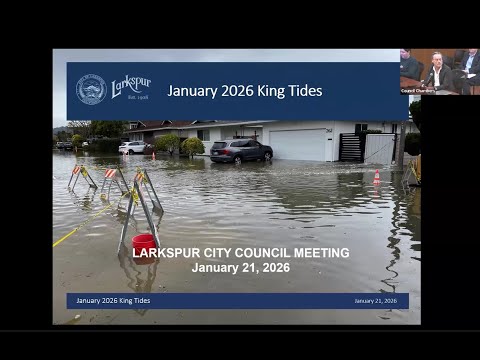
Officials: 'Extreme' king tides and creek overtopping flooded Larkspur streets and lagoon; residents press for faster response
Summary
City staff said Jan. 1–5 king tides and elevated creek levels produced unprecedented flooding in low‑lying Larkspur neighborhoods, with the Marina Lagoon remaining high for days; residents reported sewage and urged proactive lagoon pumping and faster communications; staff said pumps were rented, flap valves ordered and further coordination with county and Ross Valley Sanitary is planned.
Larkspur city staff told the City Council on Jan. 21 that an "extreme" Jan. 1–5 king tide cycle — with measured creek elevations up to 8.7 feet — combined with local conditions to flood multiple low‑lying streets and the Marina Lagoon, causing prolonged street and property flooding that left some residents with sewage in garages and yards.
"It seems primarily this flooding was the result of the elevated king tides," Public Works Director Julian Skinner said, explaining that regional tide gauges recorded water levels about 18 inches above prediction and that Larkspur saw higher-than-forecast creeks that overtopped banks and flowed into streets.
Skinner said the city's storm pump stations are sized to remove rainwater that collects in low areas; they are not designed to pump creek or bay water once those waterways overtop banks. "They're not sized or designed for when the creek then spills into the street, to be able to pump that water back out," he said.
Multiple Riviera Circle residents told the council their streets and garages remained flooded for days and said the Marina Lagoon was not proactively lowered ahead of the high tides. "If they lower the lagoon by a foot, that's over 4,000,000 gallons of capacity," longtime resident John Quigley said, arguing that preemptive lowering buys time for street drains to function.
Residents also reported raw sewage bubbling up in streets and driveways. "We had raw sewage bubbling up in the streets," John Thornton said. Council and staff agreed that Ross Valley Sanitary District (the regional sewer agency) should be contacted for official confirmation and remediation; city staff said they had not received formal notification of a reportable sanitary spill to state regulators at the time of the meeting.
Skinner described the city's operational response: because the Marina Lagoon is largely a passive conveyance governed by inlet/outlet pipes and weir boards, staff ordinarily rents portable pumps when a compound high-tide-plus-rain scenario is forecast. For this event staff initially staged 6-inch rental pumps, obtained a second 6-inch pump from Marin County Flood Control and later added pumps supplied by the contractor working on a bulkhead project; with three 6-inch pumps running, staff said they were able to reduce lagoon levels over several days, though repeated high tides refilled the lagoon on subsequent days.
Skinner said staff had chosen not to lower the lagoon before the event to accommodate a homeowner association bulkhead replacement project; the HOA’s contractor had requested a higher lagoon level to support its construction and staff said some aging bulkheads would have been destabilized by a lower lagoon level.
Short-term next steps staff identified at the meeting included: purchasing at least one 6-inch pump the city previously authorized to own rather than rent; installing flap/check valves where appropriate (valves on order with a roughly three-month lead time); accelerating selected pipe rehabilitation and street-sweeping where feasible; and debriefing with the county Office of Emergency Services and the Central Marin Police Authority to identify communication gaps. Council also asked staff to follow up with Ross Valley Sanitary District about reported sewage in streets and to post guidance for residents about where to report health or infrastructure hazards.
Longer-term options discussed — noted by Skinner as county- or region-level projects requiring substantial funds and public outreach — included levees or walls, tide gates at Highway 101, raising key evacuation corridors and nature-based shoreline strategies; Skinner cited two regional studies, the Bay Wave (Marin vulnerability assessment) and the Transportation Authority of Marin sea-level-rise adaptation study, as planning resources.
Council members thanked residents and staff for the on-the-ground reports and agreed staff should return with options and cost estimates for short-term operational steps while continuing regional coordination on long-term solutions.