Get Full Government Meeting Transcripts, Videos, & Alerts Forever!
Get email alerts on the Capital Improvement Programs topic
No spam. Unsubscribe anytime.
Los Gatos council approves multiyear CIP framework, asks staff to refine funding approach
Summary
The Town Council unanimously approved a staff‑proposed multiyear Capital Improvement Program framework based on GFOA best practices to improve asset management, prioritization and long‑term funding, while directing staff to refine grant treatment and staffing needs.
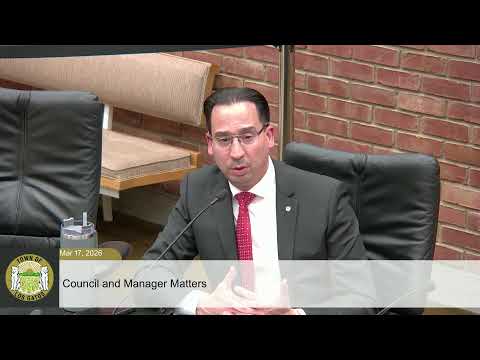
The Los Gatos Town Council on March 17 approved a multiyear Capital Improvement Program (CIP) framework that emphasizes asset management, project prioritization and a longer planning horizon, with unanimous support from the council.
Nicole Burnham, the town's director of parks and public works, told council members that the town's current CIP funding is heavily weighted to the streets program and that "about 88% of the CIP funding that is in the streets program is legally restricted," limiting how those dollars can be used. Burnham said the town receives $850,000 annually from the state under the SB 1 program, but must spend about $3.7 million a year on street maintenance to continue receiving that funding.
The staff presentation translated the Government Finance Officers Association (GFOA) best practices into a 10‑step framework for Los Gatos, including a five‑year planning horizon, needs identification and an approach to define projects by phases (feasibility, design, construction) so costs and operating impacts can be refined as projects progress. Burnham said the town will focus in the near term on building a prioritization framework, updated policies and improved communications and then work on inventorying assets and expanding the asset management system.
Council members pressed staff on several practical questions: Vice Mayor Risto and others asked whether the town should hire a full‑time staffer or a consultant to accelerate the work; Burnham said she was meeting with consultants and estimated a full asset management build‑out could be in the "hundreds of thousands of dollars," but recommended thoughtful staging and noted staff capacity constraints. The town manager added that the finance commission had recommended evaluating either consultant services or an FTE and cautioned against hiring before the town fully defined the needed scope.
Council members also raised how grants will be treated in CIP budgeting. Staff said they generally do not assume grant funding unless awarded; for large grant‑dependent projects the town must often front the costs and be reimbursed later, which carries fiscal implications.
Town engineer Gary Heap described the operational side of paving decisions and the use of tools such as StreetSaver to prioritize streets so limited paving funds generate the greatest benefit. Heap said bidding variability can also affect what work gets done in any given year.
Council member Badami moved to approve the work plan and CIP elements, including consideration of the finance commission recommendations and hiring consultant services "if needed and recommended by staff at a later date." The motion was seconded and passed unanimously.
The council directed staff to return with refined policies and implementation steps as part of the FY 2026–27 budget process; staff told the council it expects to socialize the prioritization framework with the community as the effort progresses.
The approved framework does not represent a final project list or budget; rather, it creates a policy and process structure staff will use to inventory assets, estimate life‑cycle costs and recommend specific projects and funding strategies.