Get Full Government Meeting Transcripts, Videos, & Alerts Forever!
Get email alerts on the General Plan topic
No spam. Unsubscribe anytime.
Rohnert Park leaders review draft General Plan 2040; consultants outline EIR, land-use changes and next steps
Summary
At a joint study session Feb. 5, Rohnert Park city officials and planners discussed the draft General Plan 2040, including a new business-park land-use category, housing opportunity sites, a climate element and plans for an environmental impact report; public comment focused on water, schools and active-transportation concerns.
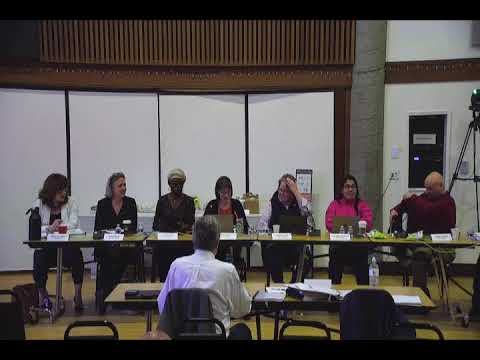
Rohnert Park's City Council and Planning Commission met in a joint study session on Feb. 5 to review the draft General Plan 2040, receive public comment and hear presentations from the city's consultants on the plan's vision, new elements and map changes. No formal action was taken; the Planning Commission is tentatively scheduled to hold a public hearing on March 12, 2026, followed by a City Council hearing on April 14, 2026.
Consultant Barry Miller told the joint body the general plan sets a 20-year horizon and serves as the city's policy "blueprint" for land use, circulation and public facilities. He said the update, which began in 2018, adds new elements including a climate-change element, an economic development element and a racial, social and environmental justice element, and reorganizes goals, policies and implementation programs to emphasize delivery and tracking. "The general plan, as you'll see in the slides, has been actually underway for about 8 years now," Miller said.
Miller and project director Jim Harnish said the city published a draft environmental impact report (EIR) on Nov. 21, 2025, extended the public comment period, received comments and is preparing responses. Staff told the council and commission the final EIR will be completed in advance of the March 12 planning commission hearing. "We are tentatively looking at our first planning commission public hearing on 03/12/2026," Miller said.
Key map and policy changes highlighted in the presentation include:
- A new "business park" designation mapped in the northwest portion of the city to encourage employment-focused uses, higher-paying jobs and a flexible mix of office, light industrial and institutional uses; the draft does not make the area residential.
- Two housing opportunity sites identified by the adopted housing element: one recently rezoned site at 5435 Snyder and a four-acre church site at 5150 Snyder (St. John's) that would be rezoned to permit high-density residential per the city's commitment to the state.
- Portions of Southwest Boulevard east of the freeway are proposed to change from neighborhood commercial to mixed-use to allow housing above retail in the future; a subsequent rezoning will be required to align zoning with the general plan map.
Miller emphasized that the vast majority of the city would not change under the draft map. "Most of the city is not changing," he said, adding that rezones and new zoning districts will follow adoption to implement the general plan's policies.
Council members and commissioners pressed staff and consultants on implementation and accountability. Several speakers urged using the annual general-plan progress report to tie plan programs to departmental budgets and to keep implementation front and center. Harnish recommended periodic five-year reviews and said departments should be listed with responsibility and timelines in the plan's implementation tables.
Public commenters and council members raised substantive concerns during public comment and the Q&A, including water supply, school capacity, and the effects of electrification technologies. Steve Keith, a resident, urged caution on lifecycle impacts of electrification and other technologies: "Technologies that electrify our daily life carry with them different environmental impacts that deserve thorough consideration and planning," he said. Former mayor Jake Mackenzie urged a water-supply assessment and pointed to unfinished recycled-water infrastructure in the northern third of the city.
Active-transportation and safety also drew sustained attention. Commissioners and residents urged more protected bike lanes, lighting on creek-path and smart-path connections and stronger enforcement and education around electric bicycles and scooters near schools. The police chief said enforcement and educational outreach through schools have increased and that officers issue citations when violations are observed.
The draft also adds or strengthens resilience and safety programs, including evacuation planning and wildfire mitigation in the safety element, and more detailed stormwater and recycled-water policies in the public-facilities element. Staff noted that the plan and the EIR identify certain impacts as significant and unavoidable (for example, construction noise), and that mitigation measures and project-level review will be used to reduce operational impacts.
Next steps: staff will finish responses to EIR comments and present the final EIR and the draft general plan to the Planning Commission on March 12, 2026 (tentative). If the commission acts, the City Council could consider the plan and the EIR in a subsequent public hearing tentatively scheduled for April 14, 2026. Because the meeting was a study session, no motions or votes were taken.
Reporters and residents can find the draft documents and submission instructions on the project website at envisionrp.com; staff provided an email address for written comments and reiterated the opportunity to submit further input before the public hearings.