Get Full Government Meeting Transcripts, Videos, & Alerts Forever!
Get email alerts on the Land Use topic
No spam. Unsubscribe anytime.
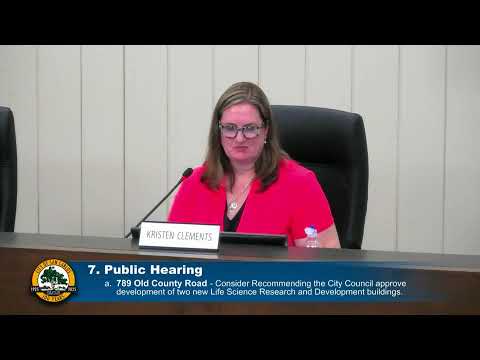
San Carlos planning commission backs 789 Old County life‑science project despite neighborhood objections
Summary
The Planning and Transportation Commission voted unanimously to recommend the City Council certify a mitigated negative declaration and approve plan‑development zoning, a development agreement and design review for a two‑building life‑science campus at 789 Old County Road. Neighbors pressed for more outreach and argued the project violates the East Side Vision Plan.
The San Carlos Planning and Transportation Commission on Sept. 2 voted unanimously to recommend that the City Council certify a mitigated negative declaration and approve plan‑development zoning, a development agreement and design review for a proposed life‑science campus at 789 Old County Road.
The proposal would redevelop a 3.4‑acre industrial parcel at Old County Road and Branston into two life‑science research‑and‑development buildings and an above‑grade parking structure, with a central plaza, expanded sidewalks and new streetscape improvements. Staff said the West building would be four stories (about 69 feet) and the East building five stories (about 85 feet to the roofline) with mechanical screening above. The applicant and staff described a community benefits package valued at about $4,200,000 and estimated impact fees and related obligations at roughly $11,600,000, for a combined financial commitment the applicant described as about $16,000,000.
"The applicant proposes to provide the city with community benefits totaling over $4,200,000," said Lisa Costa Sanders, principal planner, during the staff presentation. The package includes off‑site pedestrian and bicycle improvements, a tree‑planting fund (roughly $30,000 for nearby residents), and payments at building‑permit issuance. Staff also noted the applicant will pay its fair share toward a new traffic signal and construct a two‑way cycle track on Old County Road.
Why it matters: the project would transform a concrete‑and‑truck yard site near San Carlos’s Caltrain station into an employment campus designed for transit access. Staff and the applicant emphasized trip‑reduction measures and bicycle infrastructure; consultants said the transportation demand management (TDM) plan is intended to achieve a roughly 27% trip reduction and will require annual monitoring and TDM reporting.
CEQA and environmental review
Rebecca Alderland, the project CEQA consultant, told commissioners that an environmental impact report is required only if the analysis demonstrates significant and unavoidable impacts. "Mitigated negative declaration is the appropriate document under CEQA," she said, adding the team concluded the identified impacts could be mitigated with measures included in the document.
What neighbors said
More than a dozen residents and representatives of the Greater East Side community spoke during public comment. Several homeowners along Hall Street and nearby blocks urged stronger outreach and clearer sightline/rendering materials showing backyard and second‑floor views. "I feel like there's been not much outreach to us who are going to be impacted by it," said Elizabeth Rossi, a nearby resident, asking for view‑point renderings and follow‑up contact during construction.
Residents also argued the proposal does not comply with the East Side Innovation Vision Plan and urged the commission to require a full environmental impact report. "This does not comply with the East Side vision plan," said Jennifer Rossi, a neighborhood group leader, who asked for clearer elevation diagrams that include mechanical screening and full building heights.
Supporters and trade testimony
A union representative and some neighborhood members voiced support. Scott Beal, a business representative for the local plumbers’ union, urged approval, saying the project would bring sustainable jobs and use local construction labor.
Commissioner concerns and staff clarifications
Commissioners pressed staff and the applicant on several technical points: why the project exceeds the base height and floor‑area ratio (staff explained PD zoning allows site‑specific deviations when community benefits offset added development value), how the fiscal benefit value was calculated (staff cited a consultant valuation of approximately $8.4 million in added building area, split roughly 50/50 in negotiated benefits), details of TDM enforcement and annual reporting, bird‑safe glazing and planting selection (landscape architects said a Brisbane box evergreen was chosen for year‑round screening), and how long construction would take.
Staff clarified outreach and notice: the city said it followed standard mailed notice procedures, expanded the typical 300‑foot notification to a 600‑foot radius for this hearing, and also participated in an open‑house outreach event in January. Staff said the project was circulated as an MND for a 30‑day public review period and that the GESC (Greater East Side Coalition) letter appears in the CEQA packet's response‑to‑comments appendix. The development agreement grants the developer entitlement rights for 15 years, but staff and the applicant estimated the actual construction period would be about 18 months to two years once work begins.
Commission action and next steps
The commission passed three motions on unanimous roll call (Commissioner Anand, Commissioner Kennedy, Commissioner Tapias, Vice Chair Bundy and Chair Clements voted "yes" on each): to recommend that the City Council certify the mitigated negative declaration and adopt the mitigation monitoring and reporting plan; to recommend adoption of the plan‑development zoning and the development agreement as amended (including revised condition wording limiting signage on the north elevation and flexibility to use tree‑planting funds for residents' window treatments); and to approve the design‑review certificate, transportation demand management plan and grading/dirt‑haul certificate subject to conditions. The commission's design‑review approval can be appealed to the City Council within 10 days.
What remains open: residents who objected said they will press the City Council for additional review and asked that city staff document outreach dates, attendees and meeting notes to improve transparency. Staff indicated the item is tentatively scheduled for the City Council on Oct. 14 and said it will use the same expanded 600‑foot notice for that hearing.
Reporting notes and limitations
This article is based solely on the Planning and Transportation Commission hearing record and public comment presented at the Sept. 2 meeting. Where the transcript or speakers used dollar figures or counts without additional documentation, the article reports those numbers as presented at the hearing. Details such as final development‑agreement language, building permits timing, and precise impact‑fee escalator language will be set in later City Council actions or in the final agreement documents.
The commission's recommendation now goes to the City Council, which has the authority to approve or modify the zoning, development agreement and related entitlements.