Get Full Government Meeting Transcripts, Videos, & Alerts Forever!
Get email alerts on the El Camino Renewal topic
No spam. Unsubscribe anytime.
Caltrans outlines phased El Camino Real renewal; tree removals, detours and staggered closures expected starting this winter
Summary
Caltrans told the Burlingame commission it expects to start El Camino Real construction in late December or January, with multi-year staged work, daytime closures for large-tree removals, coordinated detours and a public outreach plan; residents urged more night/weekend work and earlier school outreach.
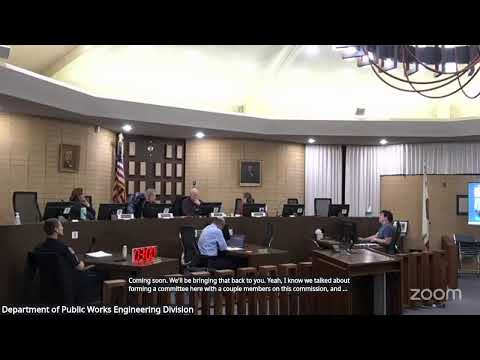
Caltrans briefed the Burlingame Traffic Safety & Parking Commission on the El Camino Real renewal, describing a multi-stage construction program across a roughly three-mile corridor that runs primarily through Burlingame with sections in San Mateo, Millbrae and Hillsborough.
Rommel Pardo, Caltrans regional project manager, said the project will repair failed pavement, upgrade sidewalks to ADA standards, address drainage and localized ponding, improve driver and pedestrian sight lines, and replace hazardous eucalyptus trees. Caltrans said it completed full design and has onboarded a contractor; start of construction is targeted for late December or January, subject to weather, the holiday season and critical coordination such as PG&Eundergrounding of overhead utilities.
Construction will proceed in stages with crews working in two-block segments and shifting traffic to maintain access where feasible. Caltrans said stage 1 (late Dec/Jan through May) will remove northbound trees and perform drainage work while later stages (through 2029) will repair pavement, replace sidewalks and replant trees. Caltrans estimated removing about 136 trees in initial northbound work and around 400 total trees across the project, with plans to replant roughly 450 trees — a net increase of about 50 trees — using a eucalyptus variety with a narrower mature spread to retain the grovecharacter while reducing roadway hazards.
"We are aware of the inconvenience construction does bring," Rommel Pardo said, adding Caltrans will try to reduce traffic impacts and coordinate closely with Burlingame and neighboring cities. Gary Lai, Caltrans construction manager, said removal of large trees will sometimes require daytime full closures for crane operations and that detour maps and on‑street signage will guide travelers.
Janine Crawford, Caltrans public information officer, described a layered outreach plan that includes mailers to corridor addresses, social media, the project website (elcaminorealproject.com), a traffic‑advisory email list and coordination with city staff to publish three-week "look-aheads" of upcoming work. She said more than 300 Burlingame residents had already signed up for the project's advisory list.
Residents and commissioners raised concerns about detour routing through narrow residential streets, access to homes during closures, emergency vehicle access and the impacts on schools, places of worship and downtown traffic during the holiday season. Several residents urged night or weekend work to reduce daytime congestion. Caltrans said weekend work is possible in places and night work is under consideration but must be balanced with noise impacts for adjacent residents; Caltrans emphasized that much work will be daytime operations and short daytime full closures when necessary for safety.
Commissioners asked Caltrans to coordinate earlier with Burlingame schools and to consider text alerts or other broader notification methods beyond email to reach more residents; Caltrans said it would explore county alert systems and welcomes city contacts to expand outreach lists. Caltrans also said they intend to post detour signage on regional routes and work with city engineers to refine diversion plans so local streets are not overburdened.
Caltrans emphasized the work remains subject to change as PG&E undergrounding and other utilities are sequenced, and said residents will receive look-ahead notices two to three weeks before block closures. The agency said it will hold weekly coordination meetings with the city during construction and provide a resident engineer and radio room contact for urgent issues.
Next procedural steps include finalizing PG&E sequencing, confirming contractor schedules and continuing public outreach; Caltrans asked the commission and city staff to provide contact lists for schools, churches and businesses to ensure timely notifications.