Get Full Government Meeting Transcripts, Videos, & Alerts Forever!
Get email alerts on the Environment Marine topic
No spam. Unsubscribe anytime.
High-school surfer urges Rancho Palos Verdes to back kelp restoration
Summary
A Chadwick School senior urged the Rancho Palos Verdes City Council to explore partnerships, set modest pilot funding and support grant applications to restore local kelp forests, warning that kelp off the peninsula has declined sharply and that hands-on restoration is needed to reverse urchin "barrens."
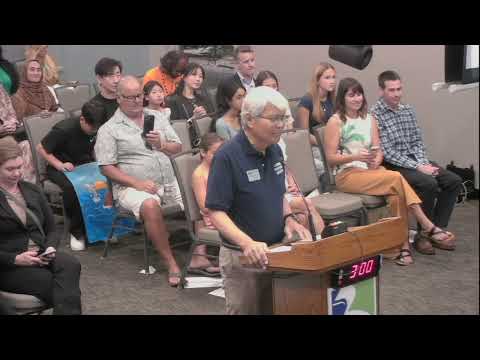
Michael Schnabel, a senior at Chadwick School, told the Rancho Palos Verdes City Council that kelp forests off the peninsula have declined ‘‘by more than 80% in the last century’’ and urged the council to act to protect and restore them.
Schnabel asked the council to direct staff to explore partnerships with organizations already working locally—he cited the Bay Foundation—set aside modest pilot funding in a future budget for kelp restoration work, and position the city to support outside grant applications for coastal and ocean resilience programs. "I'm asking for this because I've watched our kelp forest disappear in real time," he said.
In his five-minute public comment, Schnabel described the ecological role of kelp: providing habitat for reef fish, suppressing harmful algal blooms and supporting the food web that sustains larger species and migrating whales. He said the collapse of predator populations, particularly the sunflower sea star, allowed purple sea urchins to proliferate and convert reef into ‘‘urchin barrens,’’ and that in some coves active restoration that reduces urchin densities has led to kelp recovery.
Council members asked clarifying questions about restoration methods and predators; Schnabel said that in some places reintroducing or restoring predators has been tried but faces constraints, including disease impacts on sea star populations and the effects of ocean warming. He recommended that the city pursue partnerships and grants rather than attempting large-scale work alone.
The comment was made during the council's public comment period; no formal action was taken that night. The request adds to a growing body of local advocacy for marine restoration and could inform future staff work plans or grant-seeking by the city.