Get Full Government Meeting Transcripts, Videos, & Alerts Forever!
Get email alerts on the Governance Ordinance Brown Act topic
No spam. Unsubscribe anytime.
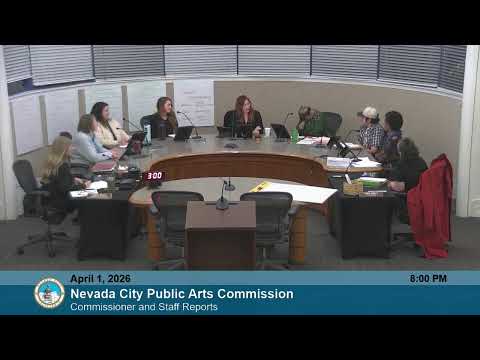
Nevada City Public Arts Commission holds workshop to clarify role, ordinance and Brown Act rules
Summary
At its April 1 workshop, the Nevada City Public Arts Commission reviewed its ordinance, heard a mayoral overview and a city manager'led primer on the Brown Act, and began drafting five-year strategic priorities ranging from a 7 Hills Arts District to sustainable funding and artist support.
The Nevada City Public Arts Commission on April 1 held a workshop aimed at reconnecting the advisory body with its founding purpose, clarifying roles under the city ordinance and reviewing open-meeting rules that govern commissioners.
Mayor Klein told commissioners the group has contributed visible projects such as the Mosaic Mural, Painted Pianos and the CHAMP Gallery, and described the workshop as "a positive reset" to strengthen the commission for long-term success.
City Manager Carrie Wright, who facilitated the session, summarized the ordinance's core functions and emphasized that the commission primarily serves an advisory and strategy role while implementation typically falls to staff or partner organizations. "Because Nevada City operates with a very small staff, it is important that the commission function primarily as a strategic and advisory body," Wright said. She also reviewed the Brown Act and Rosenberg's rules of order, outlining limits on communications outside public meetings and the public-records implications of emails, texts and social media exchanges.
Why it matters: the workshop sought to reduce confusion about what the commission can and should do given limited city staff capacity, and to identify priorities the commission can lead versus work staff or partners must deliver.
Commissioners used a facilitated exercise to list three five-year goals each. Recurring priorities included creating a clearer public-art application process and reliable funding; developing the 7 Hills Arts District; increasing support and visibility for local artists; finding ways to integrate art into new development and public projects; and improving outreach so residents understand opportunities to propose or host work. Commissioners also recommended making a city-owned site map and a simple "how to apply" guide for artists.
The city manager flagged staff constraints: there is no dedicated staff liaison to the commission, and planning and finance personnel who have assisted are currently working at capacity. Wright said staff would document the input from the workshop, return a draft of prioritized items in May and identify which actions require ordinance amendments, funding, or partnerships.
Commissioners pressed for clarity on Brown Act compliance. Wright warned that a majority of the seven-member commission may not deliberate about city business outside a public meeting (including by group text or social media), and reminded commissioners that relevant messages and notes can be responsive to public-records requests. "The easiest rule is do not discuss city business with more than one other member outside of the public meeting," Wright said.
Commissioners and staff also discussed whether the commission should pursue a public-arts master plan or use smaller, targeted policies and resources to achieve near-term goals. Wright said staff would return options and next steps, including a timeline for any ordinance changes.
The meeting continued into a separate agenda item about the CHAMP Gallery.
The commission adjourned after approving a separate motion on the CHAMP Gallery partnership and exhibit theme (see related article).