Get Full Government Meeting Transcripts, Videos, & Alerts Forever!
Get email alerts on the Housing Development topic
No spam. Unsubscribe anytime.
Los Gatos planning commission recommends North 40 Phase 2 to council, adds conditions to secure affordable units and landscaping
Summary
The planning commission voted 5–2 to recommend Town Council approval of Grosvenor’s North 40 Phase 2 project (450 units) with conditions requiring at least 17% below‑market (BMP) units during buildout, a 100% affordable building with 25% of those units prioritized for residents with developmental disabilities, specified landscaping swaps, and construction‑management limits.
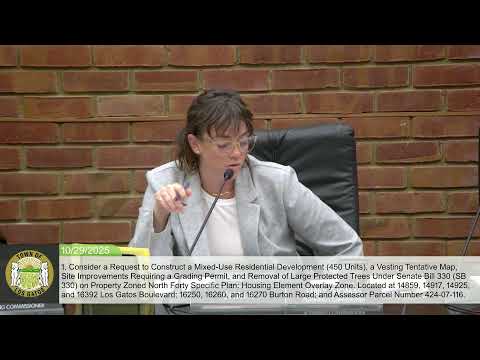
The Los Gatos Planning Commission voted 5–2 on Oct. 29 to recommend that the Town Council approve the North 40 Phase 2 mixed‑use housing development, while attaching conditions intended to guarantee the delivery of below‑market housing and to tighten landscaping and construction‑activity requirements.
The recommendation covers Grosvenor’s proposal for 450 total homes — 127 townhomes, 255 multifamily rental units (including 10 permanently affordable units in the mixed‑income building), and a separate 100% affordable building with 68 units — plus about 7,800 square feet of commercial space and extensive site infrastructure. The motion accepted staff findings and included a condition that at least 17% of residential units permitted and occupied at any time be BMP (below‑market) units until the project reaches specified milestones; it also asked the applicant to record deed restrictions and to include a 25% preference within the 100% affordable building for people with intellectual and developmental disabilities.
Why it matters: The project is one of the town’s largest housing investments and directly relates to Los Gatos’s certified housing element obligations and the state’s RHNA allocations. That makes the outcome significant for the town’s ability to meet regional housing obligations and for local families seeking long‑term affordable options, especially those with developmental disabilities who advocates said would benefit from on‑site supportive services.
What the commission heard: Town staff and legal counsel framed the basic legal contours for tonight’s deliberations, flagging four laws relevant to the proposal: Senate Bill 330 (project vesting), the Housing Accountability Act (Government Code section 65589.5), state density bonus law (incentives/waivers/waivers), and CEQA tiering under CEQA Guidelines section 15183. Town Attorney Gabrielle Whelan told the commission the town must weigh any condition that could render the project infeasible and that the town bears the burden of demonstrating infeasibility under the Housing Accountability Act.
Developer Grosvenor emphasized financing realities and phasing. Senior Vice President Steve Busters said the infrastructure build‑out is large: “We are going to be approaching a $100,000,000 of investment before the first home is even completed,” he told the commission, arguing the developer needs flexibility to build some market‑rate components first to underwrite the backbone infrastructure and then deliver the affordable product.
Eden Housing, the proposed partner for the 100% affordable building, described typical tax‑credit funding cycles and timelines. Dixie Bals of Eden said an optimistic, best‑case timeline from entitlement through design and awarded financing to groundbreaking could be about three years, but added that entitlements are a threshold for state and county funding applications.
Public testimony was divided but focused heavily on housing for people with developmental disabilities. Multiple speakers — including parents and nonprofit leaders — urged approval and highlighted the project’s set‑asides. Catherine Mancuso said she hoped the project would let adults with intellectual disabilities stay near their support networks: “The longer this goes on, the less affordable everything gets,” she said, asking commissioners to move the project forward. Housing advocates also urged the commission to consider the regional housing need and the project’s contribution toward the town’s RHNA commitments.
Deliberations and conditions: Commissioners spent much of the meeting testing two competing approaches to ensuring affordable housing delivery: staff’s recommended approach (a strict requirement that 17% of units be BMP throughout construction) and the applicant’s proposed alternative that would allow flexibility in phasing while providing deed restrictions and other security. The commission’s motion accepted staff findings but incorporated multiple additions discussed during the meeting: a requirement that the 100% affordable building include a 25% preference for residents with intellectual and developmental disabilities, revisions to the landscape palette to favor native and drought‑tolerant species (removing invasive butterfly bush and swapping some perimeter species), and construction‑management conditions limiting on‑site impacts (e.g., prohibiting staging or long‑term idling of construction vehicles on Los Gatos Boulevard without public‑works approval).
Legal and procedural notes: Counsel cautioned that several technical issues remain open with the state Department of Housing and Community Development (HCD) — in particular, questions about the interpretation of “seek and agree” under density bonus eligibility and how gross lot area calculations should be applied under density bonus law. Commissioners debated whether to continue the item to await HCD guidance; a majority voted to forward the recommendation to council with the conditions recorded in the motion and to allow council and staff to continue technical conversations with HCD as needed.
Outcome and next steps: The commission’s recommendation (5–2) sends the project and the attached conditions to the Town Council for final action. The recommendation includes specific conditions of approval and requires recording affordability deed restrictions, commitment of the 25% preference in the 100% affordable building, agreed landscaping swaps, and construction‑management measures. The council will review the commission’s recommendation and the record at a future meeting; staff and the applicant indicated they will continue technical outreach on outstanding state law questions.
Quoted in the hearing: Town Attorney Gabrielle Whelan summarized the laws at stake: “There are 4 major laws that are implicated with this application,” and developer Steve Busters emphasized financing constraints: “We are going to be approaching a $100,000,000 of investment before the first home is even completed.” Advocate Catherine Mancuso pressed the commission on local needs for neurodiverse residents: “The longer this goes on, the less affordable everything gets.”
What to expect: The Town Council will take up the commission’s recommendation. Staff said they will continue discussions with the developer and HCD on narrow technical questions raised in public comment and by commissioners. If the council approves the project, staff and the applicant will proceed to finalize the affordable‑housing documentation and the construction and landscaping conditions the commission required.