Get Full Government Meeting Transcripts, Videos, & Alerts Forever!
Get email alerts on the Land Use topic
No spam. Unsubscribe anytime.
Neighbors, planners press Nevada City Council to protect scenic corridor as Caltrans-led SR‑49 work advances
Summary
Neighborhood groups and a landscape architect urged the council to use the city’s scenic-corridor combining district and to negotiate landscaping, medians and irrigation with Caltrans as roundabout and roadway changes along Highways 20/49 proceed; staff and council agreed to pursue interagency talks while noting limits on city authority in Caltrans right-of-way.
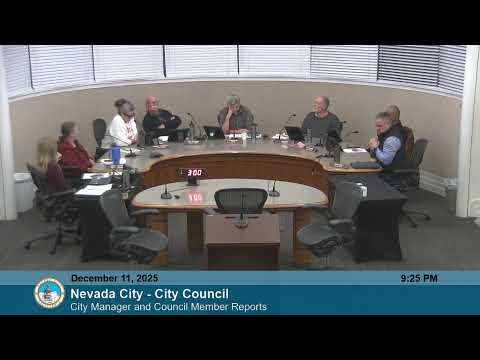
A presentation from neighborhood groups and a landscape architect on Dec. 11 urged the Nevada City Council to treat the city’s Scenic Corridor combining-district as a framework for preserving Highway 20/49 visual character as regional safety and roundabout projects proceed.
Brian (the landscape architect) said the ordinance’s intent is to "preserve the existing tree cover" and recommended using setback areas, multi-layered plantings and medians planted with shrubs and deciduous trees to soften paved roundabouts and minimize visual impacts. He flagged that planned improvements will affect roughly 6–7 acres of paving, about 11 acres of remaining right-of-way area, and another ~8.5 acres of city setback areas that could be used for screening.
Council members and NCTC staff agreed there is value in negotiating design standards and maintenance agreements with Caltrans, but both sides were clear about jurisdictional limits. The city attorney previously noted that the municipal code cannot bind Caltrans on state right-of-way, so any cooperative maintenance or planting agreements would be negotiated rather than enforced by ordinance.
Council members emphasized two constraints that must be balanced: fire-safety vegetation spacing and the need to accommodate evacuation-capable shoulders Caltrans may require. Several councilors said they prefer vegetated medians and irrigation where feasible rather than expanses of concrete, and asked staff to pursue conversations with Caltrans and NCTC on irrigation meters, maintenance agreements and planting palettes that meet both safety and aesthetic goals.
The meeting produced no formal legislative action but resulted in direction to staff and continued engagement among the city, NCTC and neighborhood groups to shape design decisions during the Caltrans-led design phase.
What happens next: Council asked staff to keep pursuing coordinated design and maintenance options with Caltrans and NCTC, using the scenic corridor policy as a guide where feasible, and to report back during the project design phase.