Get Full Government Meeting Transcripts, Videos, & Alerts Forever!
Get email alerts on the Transportation topic
No spam. Unsubscribe anytime.
Nevada City hears $13.9 million State Route 49 multimodal plan amid neighborhood concerns over roundabouts and traffic
Summary
Nevada County Transportation Commission staff updated the Nevada City Council on a $13.9 million Active Transportation Program award to build pedestrian, bicycle and intersection safety improvements on State Route 49; residents urged design changes — including excluding Orchard Street from a planned roundabout or converting Lower Coyote Street to a cul-de-sac — and Caltrans alternatives could add roughly $1.5 million in right-of-way costs.
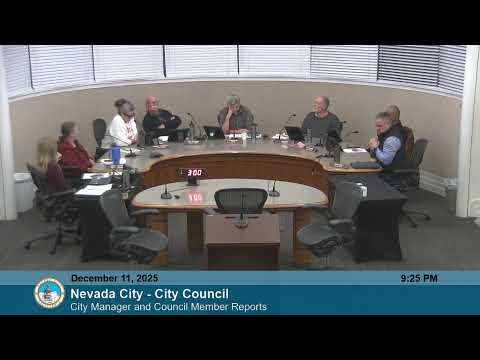
NCTC executive director Mike Woodman told the Nevada City Council on Dec. 11 that the State Route 49 multimodal corridor project has secured an Active Transportation Program award and supporting funds totaling $13,900,000 to implement corridor improvements, including four intersection upgrades, two single-lane roundabouts and a 10-foot multi-use path.
"NCTC was successful in securing the ATP funds and was awarded $13,900,000 to implement the project," Woodman said, summarizing the grant award and the project’s broad purpose: to slow traffic, improve crossings and add dedicated space for pedestrians and cyclists.
NCTC’s deputy executive director, Aaron Hoyt, outlined specific design elements planned at several intersections: "At Coyote Street the modifications would include left-turn pockets on State Route 49 onto the side streets, high-visibility crosswalks, pedestrian-activated rectangular rapid flashing beacons," he said, adding shelter upgrades for transit stops and continuous multi-use path connections.
The presentation stressed that the project grew from resident safety complaints and a 2018 pedestrian fatality; the planning process included public workshops in 2019, an October open house and an online portal that drew 201 survey respondents. Staff said roughly 60% of online respondents said they would feel safe using the proposed multi-use path and 63% believed roundabouts would reduce speeds and improve crossings.
Residents and neighborhood groups used the council meeting to press for design changes they said would protect narrow local streets. Bob (who spoke for Lower Coyote residents) asked the council to convert Lower Coyote Street into a cul-de-sac "to protect our neighborhood" and requested NCTC adjust plans accordingly.
NCTC acknowledged alternatives are possible but cautioned that significant changes could trigger a scope review with the California Transportation Commission. Staff described one Caltrans-conceived bypass alternative for the Orchard roundabout that would cost an estimated $500,000 to construct and might require additional right-of-way purchases, bringing the added cost to roughly $1.5 million.
"The bypass alternative would close the entrance to the roundabout and give that eastbound right-out access only," Woodman said, and added that such an alteration would need CTC review because it represents a material scope change from the grant application.
Council members pressed project staff on three linked issues: preserving pedestrian safety, avoiding predictable cut-through patterns that burden historic neighborhood streets, and protecting evacuation capacity. Several council members urged staff to explore design tweaks that retain grant eligibility while addressing neighborhood concerns, including right-turn-only options, enhanced crosswalks with rapid-flashing beacons, and targeted landscaping that does not compromise fire-safety clearances.
NCTC said preliminary design and environmental documentation are expected in late January 2026, with Caltrans-led final design through 2028–2029 and construction tentatively in 2030–2031, contingent on CTC approvals and state budget constraints. Staff committed to continuing public outreach and bringing revised designs back to the council during the design phase.
What happens next: NCTC will continue design work and follow up with council and neighborhood representatives about possible scope changes, costs and mitigation options; any changes that materially alter the grant scope would require CTC approval and could affect funding levels.