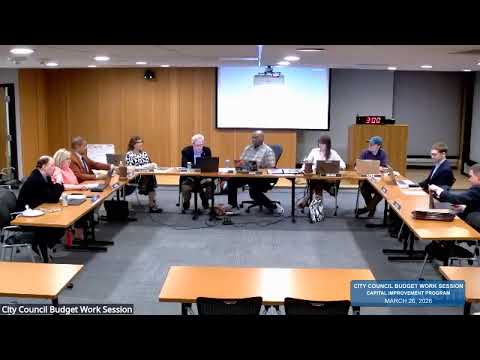
Charlottesville council reviews $47M FY27 CIP, warns rising debt service will constrain future projects
Loading...
Summary
Council staff presented a $47.0 million FY27 capital improvement plan and a $196.0 million five-year program, with education, transportation and affordable housing the top categories; staff and council debated parks funding, bike projects and how to manage rising debt service.
Charlottesville city staff on Thursday walked the City Council through the proposed FY27 Capital Improvement Plan, which they said totals just over $47,000,000 for the coming year and about $196,000,000 across the next five years.
"The plan for '27 is just over 47,000,000, with 196,000,000 over the 5 years," said Miss Hamill, the staff presenter. She told council that education is the largest spending category in the plan — driven primarily by additional funds for a new pre-K center — followed by transportation and affordable housing.
Hamill described several funding adjustments in the draft CIP designed to address inflation and project updates. On facilities, she said the budget increases annual funding for HVAC repairs and replacements to better match current costs, calling the change an "adjustment" to bring the city closer to actual needs.
Council members pressed staff for details about how smaller park and maintenance projects are categorized. Staff said the parks "parts and rec" lump‑sum account is intended for recurring capital refreshes like benches, bike racks, grills and water fountains, and that the city uses a $50,000 threshold as the working definition of a capital expenditure for budgeting and accounting purposes.
Parks staff outlined a 10‑ to 20‑year approach to implementing the parks master plan. For FY27 they recommended prioritizing high‑impact, low‑cost projects — signage, bench replacement, canopies and similar improvements — and programming $500,000 in the first year so residents start to see improvements while planning continues for larger investments.
Transportation discussions focused on what the CIP line items cover for bicycle infrastructure. Staff said the transportation line has been used for bike racks, some bike lane work and quick‑build experiments; larger protected bike‑lane curb projects would likely be stand‑alone streetscape efforts and require separate scoping and funding.
The draft also allocates funds for technology infrastructure and voting‑equipment replacement. Hamill told the council that roughly 78% of the FY27 CIP would be funded with bonds and that the city has used contingency and one‑time funds to smooth debt‑service needs.
"If you just look at '27, just under 78% of this plan will be funded by bonds," Hamill said, adding that the city is managing debt service to avoid cliff effects as large assets like school projects come on line.
Staff projected that annual debt service would rise from about $19.1 million in the near term to just over $26 million by 2031, and emphasized the difference between debt capacity and affordability. Councilors raised questions about whether the city should accelerate certain projects or spread costs over time; staff said they will continue to manage bond sizing and look for refunding opportunities.
Affordable housing entries in the CIP largely carried over from last year, with one notable change: $700,000 was added to the 501 Cherry line in FY28 per a recent council action, and staff said the Carlton Mobile Home Park loan has been finalized but includes a balloon payment in 2030.
Staff also gave a snapshot of Community Development Block Grant (CDBG) and HOME applications: they said 11 applicants requested funding and that request totals exceed the expected award amounts, noting a funding gap in the current snapshot.
There were no formal votes on the CIP at the session; staff said recommendations and final numbers will return to council for the remaining work session and the final adoption schedule.
The meeting closed after public comment and a motion to adjourn.
Next steps: staff will provide more granular line‑item details and spreadsheets to help council finalize decisions at the next work session.