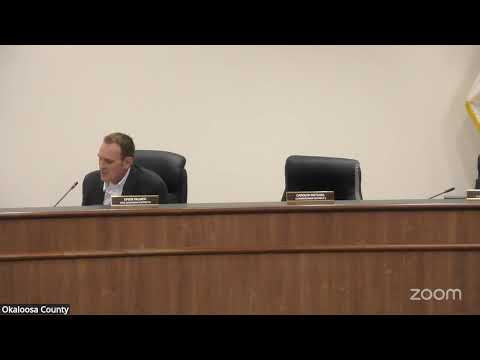
Okaloosa commissioners ban red-light and school-zone speed cameras on county roads, citing due-process concerns
Loading...
Summary
The Okaloosa County Board of County Commissioners voted 4–1 to prohibit placement of red‑light and speed‑zone cameras on county‑maintained rights‑of‑way after a Broward County judge’s order raised constitutional due‑process questions about camera‑enforcement statutes.
The Okaloosa County Board of County Commissioners on March 24 adopted a resolution prohibiting red‑light and speed‑zone enforcement cameras on county‑maintained rights‑of‑way, saying the existing statutorily framed enforcement shifts the burden onto accused drivers and raises procedural due‑process concerns.
Chair (name shown in the meeting record as the meeting chair) introduced the resolution and cited a recent order by Broward County Judge Steven DeLuca, which examined statutory burden‑shifting in camera‑enforcement schemes and concluded the procedures at issue risk treating civil‑titled violations as criminal in effect. "These cameras don’t identify a person — they identify a vehicle — and under the statute the accused often must file an affidavit naming another driver to rebut the presumption," the chair said in opening remarks.
Supporters of the ban argued that until the Legislature or courts resolve those procedural problems, the county should not authorize cameras on assets it controls. Opponents and some speakers urged caution on public‑safety grounds: Mayor JB Whitten of Crestview (a public commenter) cited a 30‑day pilot at a school corridor that recorded 847 violations and said speed cameras had reduced repeat offending at that site. The mayor urged tabling the resolution until the state action in the Broward case is clear.
Commissioner Mixon offered a friendly amendment to limit the prohibition to county roads outside municipal boundaries; the motion maker declined the amendment, saying the principle of due process applies irrespective of jurisdictional lines. The board voted 4–1 to approve the resolution.
The resolution as adopted applies to county‑owned rights‑of‑way and county‑maintained roads; it does not direct city or state agencies controlling their own rights‑of‑way. Legal staff noted the board may revise the policy later if state law changes or higher court rulings alter the constitutional analysis.
Next steps: County staff will update permitting and right‑of‑way policies to prevent vendors from installing traffic enforcement devices on county assets without board approval. The board did not take action on city‑ or state‑maintained roadways.