Santa Cruz Planning Commission weighs multimodal impact fee, sidewalks and new parking rules
Loading...
Summary
The Planning Commission reviewed staff options to reshape the city's traffic impact fee into a multimodal program, strengthen objective standards for development, and revise parking tools — including unbundled parking and tiered residential permits — to address neighborhood spillover from new, transit‑proximate projects.
The Santa Cruz Planning Commission spent its March 19, 2026 meeting discussing policy options to reduce parking spillover and make transportation investments more multimodal as the city anticipates denser, transit‑proximate development.
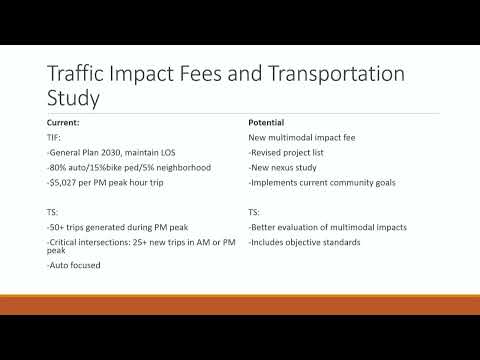
Claire Glogly, the city’s principal transportation planner, told commissioners the current traffic impact fee is "just over $5,000 per PM trip" and is largely auto‑focused, with roughly 80% of revenue allocated to auto‑oriented needs, 15% to bike and pedestrian projects and 5% to neighborhood needs. Staff said they’ve applied for a Caltrans Sustainable Transportation Planning grant to design a "multimodal impact fee" tied to a project list and measurable multimodal objectives that could direct more revenue to sidewalks, transit and bike infrastructure.
Glogly described limitations the city faces when trying to require transportation demand management (TDM) measures: because the area is in an attainment zone for air quality, the city lacks the legal leverage some jurisdictions use to compel robust TDM ordinances. She said staff are interviewing peer agencies to find workable approaches.
Commissioners and staff discussed how any new fee must satisfy the legal "nexus" between the fee charged and the projects funded. Glogly said a defensible replacement fee requires an adopted objective and a costed project list tied to that objective. Matt Starkey, the city’s transportation manager, cautioned that the fee can produce substantial revenue: "Some of the larger developments you guys see here probably bring in anywhere from a 100 to 300,000 a piece," he said, citing a Front Street project that redirected $1.5 million from the impact fee to signal improvements.
Sidewalks and safety emerged as a recurring theme. One commissioner cited the active transportation plan and said Santa Cruz’s fatal and severe injury (FSI) per capita figure is roughly double a nearby jurisdiction, and urged prioritizing sidewalks. Staff pointed to the Escalona paving project as an example of scale: the project cost about $3.9 million, with roughly half of that amount attributed to sidewalks and curb ramps.
Parking policy topics under consideration ranged from "unbundling" parking (selling or renting parking separately from housing) to changes in the residential permit program. Staff outlined options including making unbundling mandatory for projects above certain thresholds (for example, 25–100 units), and tying eligibility for on‑street permits to neighborhood parking management. For residential permits, the commission discussed lowering the number of permits per address (currently five) and moving to tiered pricing so additional permits would cost more and better reflect the public cost of curb space.
Commissioners repeatedly emphasized balancing new requirements against the goal of encouraging housing production. Several members suggested using targeted overlay zones or parking benefit districts so fee revenue is directed to nearby improvements; others recommended thresholds and small‑project screening to avoid unduly burdening neighborhood businesses or modest adaptive reuse projects.
Staff closed by saying they would return with a spectrum of options, including a prioritized project list, threshold recommendations and possible funding mechanisms. No formal action was required or taken at the meeting; staff said the discussion would inform recommendations to the City Council.