Net metering debate highlights rural co-op concerns and solar advocates’ calls for transparent valuations
Loading...
Summary
An informational session on net metering drew cooperative utilities, developers and advocates discussing how to value distributed solar: utilities emphasized rate components and contractual limits, solar industry speakers urged counting avoided costs, and testifiers agreed on the need for clearer cost-of-service analysis before statutory changes.
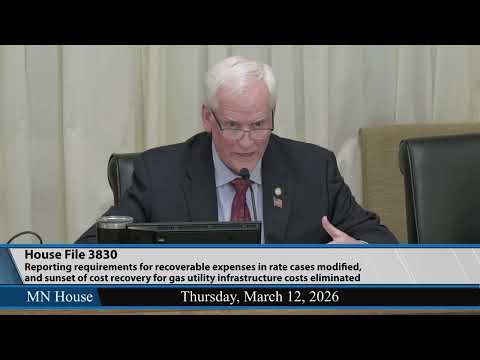
Representative Baker opened an informational discussion on net metering and said stakeholders are close to a compromise but work remains to balance affordability, rural equity and fair compensation for distributed solar.
Justin Johns, president and CEO of East Central Energy, explained his cooperative's billing construct — a baseline monthly service charge (~$46) plus a volumetric energy component (about 13¢ per kWh in his example). Johns broke the 13¢ into roughly a 4¢ distribution/other component and a 9¢ power-supply component, and emphasized that utility-scale solar provides different services than behind-the-meter rooftop systems: "solar really is an energy resource in our mind. It doesn't provide capacity," he told the committee.
Solar industry representatives disputed narrow valuations that count only foregone retail revenue. Logan O'Grady of the Minnesota Solar Energy Industries Association said exported solar should be credited for avoided peak power, transmission deferral and other benefits, and warned that a focus only on volumetric foregone revenue misses avoided system costs. Griffin Dooling (Blue Horizon Energy) and Patty O'Keefe (VoteSolar) presented data that solar penetration in many cooperative and municipal territories remains low (around 1% or less) and urged caution so policy changes do not unduly harm nascent deployment.
Members pursued technical questions about grid-access fees, three-part rates, and size-to-load proposals intended to limit oversizing while encouraging self-supply. Testimony underscored variability across co-ops — some apply fixed grid-access charges, many do not — and that long-term wholesale contracts can constrain cooperative flexibility. Several speakers said battery storage and other technologies may change the calculus over time.
The committee did not take legislative action but used the session to gather data and hold cross-stakeholder conversations. Multiple participants said they would continue negotiations on metrics such as a defensible value-of-solar framework, guardrails on system size relative to load, and transparency requirements for cost-of-service analysis.