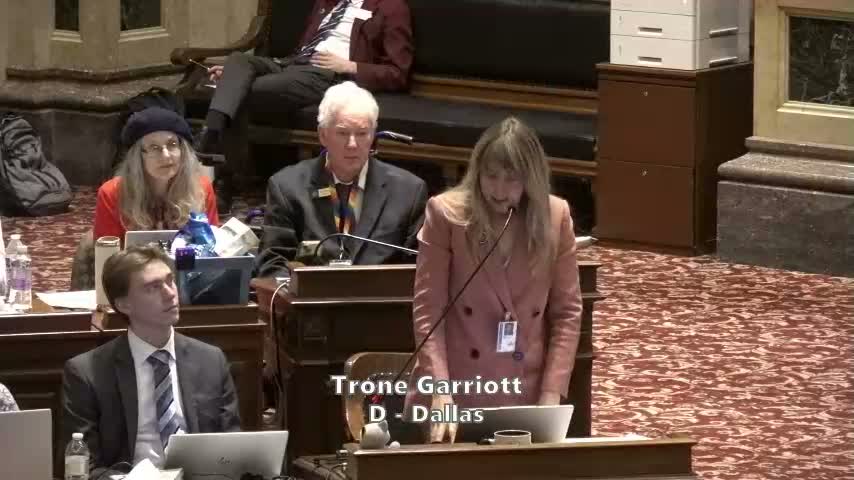
Senators debate Medicaid privatization and nitrate pollution on the Senate floor
Loading...
Summary
Senators used points of personal privilege to debate the 10th anniversary of Medicaid privatization and to trade competing claims about nitrate pollution, monitoring and health risks; no formal policy was adopted on either subject during the session.
Senators used the floor’s points-of-personal-privilege period to press competing views on Medicaid privatization, water quality and the health risks of nitrates in Iowa’s water.
Sen. Truong Garriott marked the tenth anniversary of Medicaid privatization and said the shift to for‑profit managed care has increased costs and limited care. "The cost of Medicaid to Iowa taxpayers has tripled," Garriott said, and he cited a state auditor’s report he described as showing a near‑900% increase in illegal denials or violations. He warned of expected federal cuts and urged the chamber to consider an exit strategy from the privatized model.
Others focused on water quality and nitrate spikes. Sen. Rosenboom (Marion) recited what he described as progress since Iowa’s 2013 nutrient reduction strategy — citing 2025 commitments from the Iowa Department of Agriculture and Land Stewardship (IDALS) that included $77,200,000 for conservation measures (with $34,300,000 in cost‑share), $47,000,000 in private farmer investments and more than $165,000,000 leveraged in federal and other funds. Rosenboom said cover‑crop adoption and constructed wetlands and buffers have increased and that soil mineralization and heavy rainfall contributed to the 2025 nitrate spikes.
Sen. Dotslick (Blackhawk) pushed back that Iowa still ranks highest for nitrate concentrations in waters and said private well contamination and algae blooms remain a pressing public‑health problem. "Iowa is number 1 for nitrate concentrations in our waters," Dotslick said, and he urged broader action to protect small towns with limited treatment capacity.
The floor included a pointed exchange about health risks attributed to nitrates. Rosenboom said the 10 mg/L (10 parts per million) drinking‑water standard was adopted largely to prevent infant cyanosis historically known as blue‑baby syndrome and disputed broader claims linking current nitrate levels to cancer. Rosenboom said he did not mean to suggest blue‑baby syndrome is a myth and asked colleagues to rely on soil scientists and peer‑reviewed studies. Colleagues on multiple sides urged continued debate and more sustained monitoring.
Sen. Peterson (Polk) recounted personal constituent experiences with cancer and urged the chamber to move "further and go faster" on remedies; she said she planned to attend a session on cancer the next day. Other senators, including Sen. Shipley, cautioned against singling out farmers and noted regulatory controls in place for some operations.
No formal action on Medicaid or water‑quality policy was taken during the floor session; the remarks closed with the Senate adjourning until April 2.