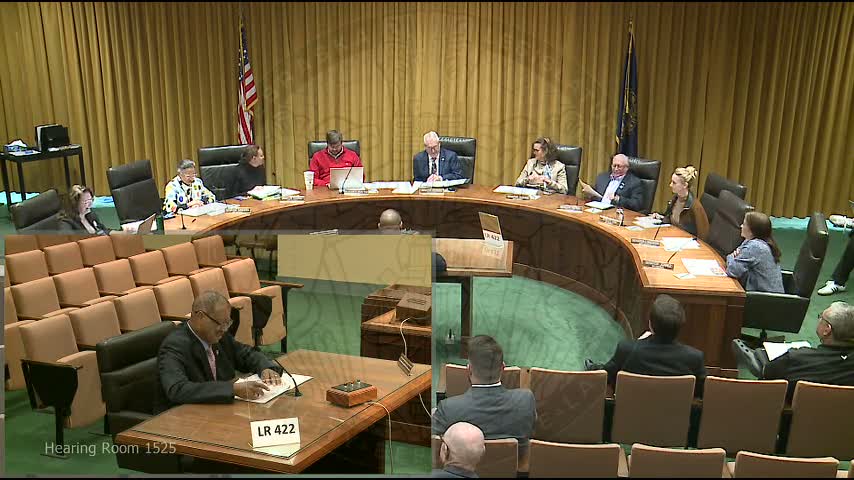
Education Committee hears testimony urging Congress to fully fund IDEA
Loading...
Summary
At a public hearing on LR 422, testifiers told the Nebraska Education Committee that federal funding for the Individuals with Disabilities Education Act falls far short of the statutory 40% commitment, leaving state and local taxpayers to cover a persistent gap. Dozens of proponents urged the Legislature to press Nebraska's congressional delegation to act.
Lincoln — The Education Committee of the Nebraska Legislature heard more than 30 proponents on LR 422, a resolution calling on Nebraska’s congressional delegation to press Congress to meet the Individuals with Disabilities Education Act’s funding promise.
Chair Sen. David Mermin presided over the public hearing and outlined procedural rules before Sen. Victor Rountree formally introduced the resolution and framed its purpose. "LR 422 asked to build upon that success and to meet the promises that were made by IDEA and the federal government to states," Rountree said, summarizing the bill and noting recent federal compliance findings by the U.S. Department of Education.
The hearing focused on longstanding federal shortfalls to IDEA. Tim Royers, president of the Nebraska State Education Association, told the committee Congress "has consistently fallen short of that requirement" and provided state-level figures he said illustrate the gap: Nebraska's federal IDEA appropriation is about $93.7 million; at a full 40% federal share, he said, Nebraska would receive roughly $291 million — a shortfall of roughly $197 million.
Ed Ventura, Nebraska's representative on the National Education Association board, urged the committee to act and described how the funding gap affects districts. "Students fall through the cracks not because educators lack dedication but because the system lacks adequate funding," Ventura said, and he cited individual district shortfalls including $815,000 for Seward, $719,000 for McCook, $1.6 million for Hastings, $35 million for Lincoln, $5 million for Bellevue, $439,000 for Wayne and $33 million for Omaha.
Colby Coash of the Nebraska Association of School Boards and Spike Eicholt of the Education Rights Council echoed those concerns and urged the committee to advance the resolution. Eicholt cited an OpenSky report that, he said, documents that Congress has not met the 40% funding threshold since IDEA’s creation.
Committee members noted Nebraska has taken steps at the state level — including an 80% state reimbursement for special education in recent years — but witnesses said the federal shortfall continues to push costs to local property taxpayers and to constrain services. When asked whether federal funding has ever reached the 40% level, witnesses indicated they did not believe it had.
Sen. Rountree closed by thanking testifiers and urging the committee to "move to bill 4, get a vote, and get it up so we can start funding coming back to Nebraska in this process." No formal committee vote was taken at the hearing; the record shows 37 proponents and no opponents on the electronic sign-in.
The hearing record will include written testimony submitted electronically and in person; committee members may decide next steps, including whether to advance LR 422 for further consideration by the Legislature.