Nebraska lawmakers advance measure enabling private power for large industrial customers after hours of debate on water, public power and tax breaks
Loading...
Summary
After hours of debate over water use, public power protections, workforce rules and tax incentives, the Nebraska Legislature advanced LB 12 61 — a bill allowing privately owned electric generation to serve large industrial customers — to E & R engrossing. Multiple transparency and labor amendments were offered; several failed.
The Nebraska Legislature advanced LB 12 61 to E & R engrossing after extended debate over whether the measure would protect public power, the state’s water resources and taxpayers while enabling privately owned power plants to serve very large industrial customers such as data centers.
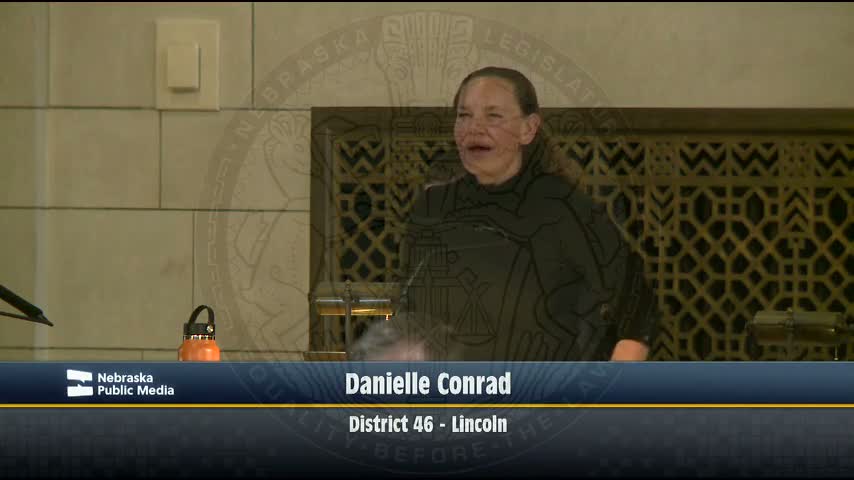
Senator Danielle Conrad, who opened floor debate, urged colleagues not to rush the bill and said policymakers still lacked essential details. “We shouldn't mortgage our land or our water or our power to massive data centers,” she said, framing the legislation as a novel carve‑out that could allow privately owned generation to sidestep long‑standing protections for Nebraska’s public power system.
Supporters, including bill sponsor Senator DeKay, said the bill is narrow and technical in scope and sought to protect ratepayers by clarifying contracting and service‑area language. On AM 28 51 — a Power Review Board technical amendment that DeKay described as cleaning up service‑area wording and replacing “board of directors” with “governing body” to fit Nebraska utilities — proponents said industry stakeholders supported the change. The Legislature adopted AM 28 51 by voice vote (34–0).
The most persistent concerns centered on water use, long‑term economic benefit and local control. Several senators said the measure could enable very large projects that use substantial power and water but provide relatively few ongoing jobs. Senator Frederickson and others cited data showing large facilities can use millions of gallons a day for cooling; Frederickson noted examples of closed‑loop and recycled water systems being used elsewhere but said the source and impacts must be transparent.
On disclosure and environmental safeguards, Senator Conrad put forward several transparency amendments. She offered AM 27 72 to require applicants to the Nebraska Power Review Board to disclose projected water use, the water source, impacts on adjacent users and whether permits are in place. Conrad described the amendment as a modest transparency step: “They just have to tell us how much water they’re planning to use, where they’re getting it from, and what the impacts are for other users.” The amendment was not adopted (12–18 recorded vote).
Labor and workforce protections were also debated. Senator Juarez proposed AM 21 32 to require prevailing wages, encourage registered apprenticeship use and protect consumer‑owned utility employees from layoffs or wage erosion tied to privately owned generation contracts. Juarez said the amendment “is about fairness, responsibility, and protecting Nebraska workers.” The chamber rejected that amendment on the record (15–32).
At several points members cited reporting by local journalists about land options and possible conflicts of interest. Senator Hunt read from an investigative article alleging a lawmaker had an option agreement with a company exploring land for a potential project; the article said a disclosure was later filed. The transcript shows discussion of disclosures and calls for scrutiny, but no formal ethics action was taken on the floor during this session.
Proponents argued the bill preserves local authority over water and zoning: Senator Mosier told colleagues LB 12 61 “has a very limited scope — it does not prevent data centers or change regulations for data centers” and said groundwater permitting remains under local NRDs and surface‑water permitting under the Department of Water and Energy. DeKay added that approval through existing local and state review processes remains possible and that contracts remain the primary governance tool between utilities and developers.
After multiple amendment votes and a sustained period of debate, Senator McKinney moved to advance the bill. On the roll call to advance LB 12 61 to E & R engrossing, the measure passed 32–13. That advancement sends the bill to the next drafting stage and keeps open additional opportunities for amendment and negotiation before final passage.
What comes next: LB 12 61 remains on the Legislature’s path. Supporters said the bill offers a framework for projects that might be proposed here; critics said the state needs clearer guardrails on water, environmental review, taxation and labor protections before authorizing novel private‑power arrangements at this scale.
The Legislature also recorded a number of related votes on amendments earlier in the day, including the adoption of AM 28 51 (Power Review Board technical changes) and the rejection on the floor of labor, environmental‑impact and other transparency amendments that would have placed additional statutory requirements on private generation projects.