Get Full Government Meeting Transcripts, Videos, & Alerts Forever!
Get email alerts on the Water Resources topic
No spam. Unsubscribe anytime.
SNWA hydrology supervisor reports stable groundwater levels, flags Colorado River uncertainties
Summary
James Prier of the Southern Nevada Water Authority told the North Las Vegas Utilities Advisory Board that long-term groundwater in the Las Vegas Valley is generally stable because of monitoring and artificial recharge, but Lake Mead projections and interstate negotiations create near-term uncertainty for Colorado River allocations.
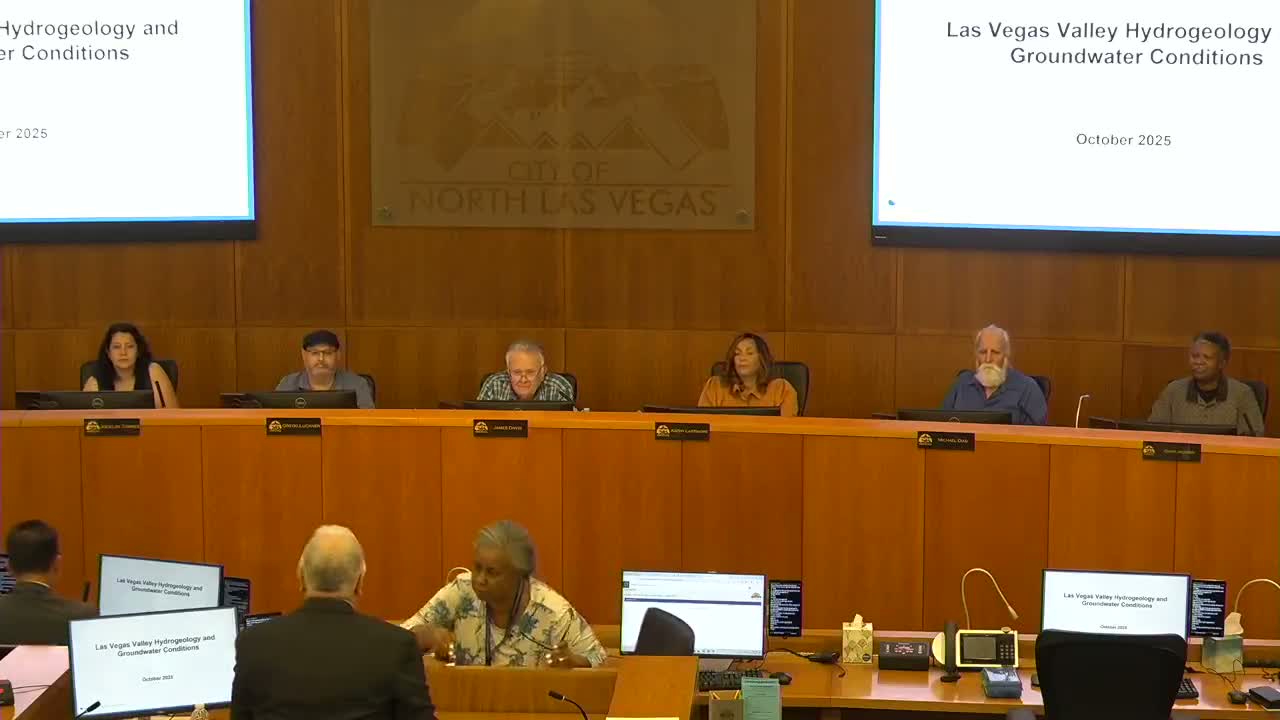
James Prier, hydrology supervisor with the Southern Nevada Water Authority, told the North Las Vegas Utilities Advisory Board on Oct. 28 that long-term groundwater levels in the Las Vegas Valley have stabilized after decades of decline because of monitoring, reduced pumping and artificial recharge programs.
"We monitor about 200 wells across the valley," Prier said, explaining that the recharge program started in 1989 and that water banking has built reserves for future emergencies. He described how earlier reliance on artesian wells and unregulated pumping produced steep declines until Lake Mead surface water use and recharge efforts helped stabilize levels.
Prier outlined the valley's hydrogeologic setting — recharge from mountain snowpack, coarse alluvial deposits in the northwest, and finer-grained materials to the east — and said water movement is generally slow once it reaches the principal aquifer. He noted that shallow wash systems have poorer quality water and are more affected by local septic and irrigation return flows.
On the Colorado River, Prier summarized recent midterm projections by the Bureau of Reclamation and the U.S. Drought Monitor, noting that Nevada’s allocation basis is roughly 300,000 acre-feet and that return-flow credits reduce consumptive demand. "Right now water levels are at 1,058 [feet]," he said, and current forecasts put the lake near the low‑to‑mid 1,050s over the coming 12–24 months, which affects tiered shortage determinations.
Prier said new interstate negotiations this November will decide allocations beyond the current agreement, and he highlighted infrastructure such as deeper intakes that provide operational buffers. Board members asked about long-distance import projects; Prier said plans to bring water from areas like Snake Valley are effectively inactive because of cost and drought risk and that the region is focusing on conservation and practical exchanges with other agencies.
Why it matters: The presentation described how the valley’s combined approach — monitoring, artificial recharge and regional planning — has arrested historic groundwater declines but left policymakers watching Lake Mead projections and interstate negotiations that could change allocations in coming years.
The board did not take formal action on the presentation; members followed with questions about specific basins and local recharge monitoring.