Get Full Government Meeting Transcripts, Videos, & Alerts Forever!
Get email alerts on the Parks And Recreation topic
No spam. Unsubscribe anytime.
Anna council hears 10‑year parks, trails and recreation master plan with targeted acreage and trail connectors
Summary
Consultants and staff presented a 10‑year Parks, Open Space, Trails and Recreation Master Plan based on 814 community survey responses; it recommends raising the city’s parkland standard from 9.2 to about 11.5 acres per 1,000 residents, identifies a ~63.6‑acre shortfall, and prioritizes trail connections and funding strategies.
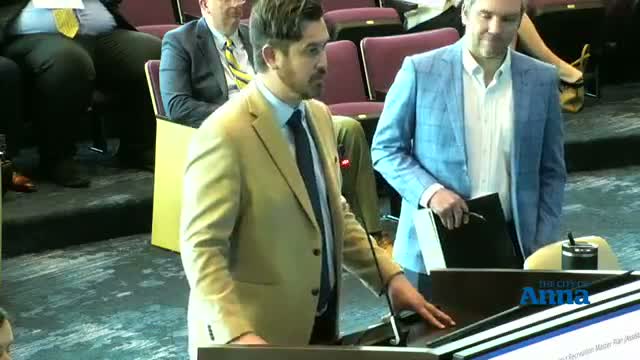
Assistant Director of Community Services Jeff Freeth opened the March 10 City Council work session to present a proposed 10‑year Parks, Open Space, Trails and Recreation Master Plan, saying the document is intended to guide park acquisitions, amenities and trail connections as Anna grows.
Wilson Kerr, project manager for Friese & Nichols, told the council the plan reflects a 12‑month process of public outreach, including 814 survey responses and multiple stakeholder meetings. "We had quite a lot of community engagement throughout this process," Kerr said, and described the plan as a prioritized action agenda that will support grant applications and implementation.
The consultant and staff framed the plan around three needs assessments — demand, standards and resource — and used National Recreation and Park Association benchmarks to evaluate levels of service. "You currently have 9.2 acres per thousand residents," Kerr said. The plan recommends a target level of service of about 11.5 acres per 1,000 residents and estimates an overall deficiency of roughly 63.6 acres to reach that target given projected growth.
Kerr and staff outlined six goals: acquire parkland and open space; enhance and diversify existing parks; expand the trail network to improve connectivity; provide a diverse range of recreation opportunities; ensure parks are safe and well maintained; and pursue partnerships and diverse funding sources. The implementation chapter ranks action items by short (1–3 years), mid (4–7 years) and long (8–10 years) timeframes and attaches potential cost ranges expressed in 2025 dollars.
Council members pressed staff on specifics. One asked whether proposed trails would tie into regional routes such as the North Central Texas Council of Governments VeloWeb network; Kerr said the plan is intended to align with future regional connections. Parks staff confirmed that park-development fees and required public-access easements tied to developer plats can be used to build trails.
Several council members urged the administration to include staffing and operating‑cost (O&M) projections alongside capital priorities so the city can budget for ongoing maintenance. "If you can lay out a plan of what you need to accommodate this, we can figure out what we need to be doing to write policy to support it," said a council member.
Council members also emphasized the value of pursuing grants and suggested recruiting a grant writer (staffed or volunteer) to improve the city’s success rate on funding opportunities. Parks staff committed to providing program participation numbers and staffing estimates to help shape budget decisions.
The presentation ended with staff saying the plan will return to council later in the month for consideration of formal adoption and will be submitted to the Texas Parks and Wildlife Department as part of typically required documentation for certain grants.
Next steps: staff will provide follow‑up materials that include program participation data, staffing and O&M projections, and any requested map updates for trail access. The council indicated a desire to see the implementation and funding plan before budget season.