Get Full Government Meeting Transcripts, Videos, & Alerts Forever!
Get email alerts on the County Budget topic
No spam. Unsubscribe anytime.
Winnebago County approves proposed tax notice after public hearing; officials cite lower levy and property-valuation gains
Summary
Winnebago County opened an 11 a.m. public hearing on a proposed tax notice, heard resident questions and staff explanations about a lower levy, higher property valuations and capital funding, and approved the tax notice by voice vote.
Winnebago County opened a public hearing at 11 a.m. on a proposed tax notice and approved the notice after brief public comment and staff explanations of why the levy request is lower for the coming fiscal year.
Committee member (S1) said the county had lowered its budget and sought to reduce taxpayer liability: "I'm proud to say that we lowered our budget this year, and we're doing a good job trying to, limit the liability of the taxpayers." That prompted questions from residents (Resident (S6) and others) about how the county could lower its request while equipment and building costs appear to be rising.
Staff member (S2) described the principal revenue sources for secondary roads spending: "If you look at secondary road budgets, ours and around the state road use tax funds about 2 thirds of the revenue property tax 1 third and it varies by county." S2 said the county reduced its secondary road budget for a second consecutive year and deferred some payments, and added that milder winters in recent years reduced salt use and plowing costs, producing rollover funds.
Committee member (S1) read figures from the tax notice to the group: last year’s requested tax dollars were listed as $7,023,000 and the upcoming year as $6,696,000. S1 and staff also discussed a rise in rural property valuations — "rural valuations went from $487,000,000 to $547,000,000" — which increases the tax base and can lower the levy rate even as total valuation grows.
Participants clarified timing for taxpayers: staff said the tax bill affected by the decision would not be realized until August 2026 and, if realized then, would be due in September 2026 and March 2027. The group also reviewed how state guidance factors into levy calculations: staff referenced the Department of Management and Department of Revenue as the entities producing the rates and formulas the county uses.
On capital funding, staff (S2) and others explained that the county financed a new secondary roads building largely by selling county properties, including the Sunnyside gravel pit and old shop buildings. S2 said the property sales generated about "900 some thousand and change" and the northern project cost roughly $1,300,000; some budgeted rollover funds were also used.
Staff described fleet management practices in detail: vehicle and equipment replacement is driven by usage and service life rather than a fixed age, with graders often reaching 25 years and trucks exceeding 400,000 miles; the county is also exploring on-road grader rebuild programs to extend equipment life.
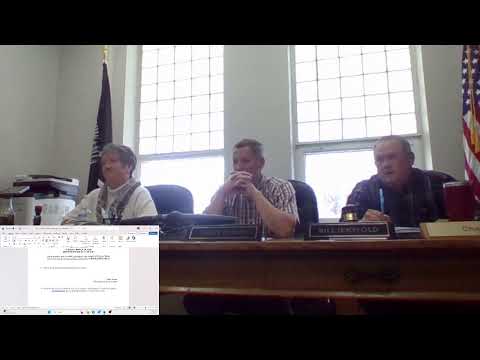
With no further public comment, a motion was made and seconded to close the public hearing. A subsequent motion to approve the tax notice was moved and seconded; the chair called for ayes and the motion passed by voice vote. The meeting adjourned shortly after 11:15 a.m.
The approved tax notice reduces the county levy as presented in the notice; implementation and exact taxpayer impacts depend on later bill calculations and school-district levies that may offset county decreases for some property owners.