Get Full Government Meeting Transcripts, Videos, & Alerts Forever!
Get email alerts on the Workforce Development topic
No spam. Unsubscribe anytime.
Board highlights High Road Construction Careers program and Caltrans partnership under SB 150
Summary
Board staff presented the High Road Construction Careers (HRCC) pre-apprenticeship program and described how SB 150 funding will be used with Caltrans to expand pre-apprenticeship pipelines tied to infrastructure projects; CalSTA emphasized equity-focused, district-level coordination and supportive services to help trainees complete programs.
The California Workforce Development Board heard an overview of the High Road Construction Careers (HRCC) pre-apprenticeship initiative and its partnership with Caltrans under Senate Bill 150. Presenter said HRCC "supports 13 pre-apprenticeship training partnerships around the state" and that SB 150 is the latest investment to align training to infrastructure project demand.
The presentation traced HRCC’s evolution: the program began with Prop 39 funding in 2014, expanded under SB 1 in 2017 with a transportation carve‑out, and was further developed through California Climate Investments and the Resilient Workforce Fund before the current SB 150 funding cycle. The presenter said HRCC’s model pairs the MC3 (multi‑craft core) pre‑apprenticeship curriculum with supportive services to improve completion and placement.
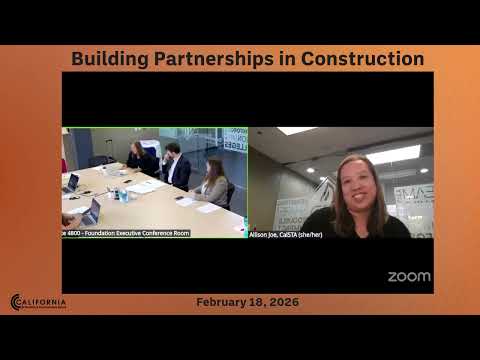
"My name is Lisonbee Jo. I am the deputy secretary for equity and workforce at the State Transportation Agency (CalSTA)," said Lisonbee Jo, who described CalSTA’s scope (Caltrans, the High‑Speed Rail Authority, the State Transportation Commission, CHP, DMV and others) and framed SB 150 as a one‑time, four‑year investment that should be used to develop district‑level partnerships and a proof‑of‑concept for longer‑term workforce ties. Jo urged regional and local partners to identify district pipeline needs so training aligns to the places with the greatest demand.
Jeremy Smith, a board member who credited Prop 39 and SB 1 for creating durable project demand, said the program’s success requires both training and job sites. "Apprentices are on a job site," Smith said, explaining that HRCC prepares participants for the realities of construction work while supports such as childcare stipends, gas cards, bus passes and tool allowances help trainees finish programs and be ready for apprenticeships.
The presentation named local partnerships and examples: People Working Together and the SACSierra Building Trades Council in Sacramento, a McCarthy Construction project at UC Davis, and Whiting‑Turner’s Aggie Square work in Oak Park where local‑hire goals were reportedly exceeded. The presenter emphasized use of the MC3 curriculum and supportive services (stipends, childcare, transportation, driver’s‑license and tools assistance, and financial‑literacy supports) to improve retention and placement into union apprenticeship programs.
No formal action or vote was taken during the presentation. The board moved next to questions from members and public commenters, and the meeting noted that board member Leonard Gonzalez was participating by Zoom and waiting to speak.