FBI outlines quality standards and CODIS prototype for Rapid DNA; addenda effective Dec. 1, 2014
Loading...
Summary
Jennifer Wendell of the FBI described new Quality Assurance Standards addenda and a CODIS prototype to incorporate Rapid DNA into accredited laboratories and to support long-term booking-station searches; she said addenda will be published and effective Dec. 1, 2014, and that modified Rapid DNA may be used now within accredited labs.
Jennifer Wendell, chief of the FBI’s Combined DNA Index System (CODIS) unit, told an ASCLAD-hosted webinar that the FBI and forensic partners will publish addenda to the Quality Assurance Standards (QAS) for DNA databasing laboratories that will be effective Dec. 1, 2014.
Wendell said the changes aim to allow accelerated use of Rapid DNA technology inside accredited laboratories now and to provide a technical path — and additional legal changes — for future use of fully automated instruments in police booking stations. “Rapid DNA is designed for use in the law enforcement booking process to analyze DNA in real time,” she said, describing the goal of producing CODIS-compatible profiles "from arrest reference samples within that booking environment."
Why it matters: the addenda set laboratory-level controls, training and review requirements that determine whether profiles developed on Rapid DNA instruments can be uploaded and searched in state and national CODIS systems. Wendell emphasized that full, hands-free uploads to CODIS require both an NDIS-approved STR typing kit and an NDIS-approved expert system, and that — as of the webinar — no instrument had both approvals.
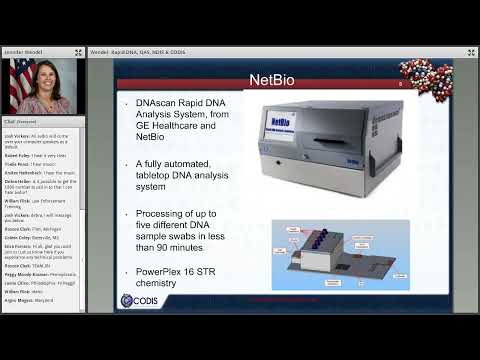
Details of validation and success rates: the FBI and federal partners ran interlaboratory and vendor tests of Rapid DNA instruments. Wendell reported an interlaboratory study of 350 buccal reference samples with an overall success rate of 87.4% (success defined as a profile at all 13 CODIS core loci). NIST-led testing of single-source samples (452 runs) returned an overall success rate of about 84.8%; other federal lab validation sets produced results in the mid-80% range. On failed runs, Wendell said failures were “mostly dropout” rather than incorrect profiles.
Standards and laboratory requirements: the QAS addenda add definitions (cartridge lot numbers, positive/negative sample controls), require documented training and competency testing for analysts operating instruments, and treat Rapid DNA cartridges and the instruments as critical reagents/equipment. Instruments used to process reference samples should be located in a pre-amplification room, not a post-amplification area, and the addenda require periodic recertification or performance checks after service, repair or extended idle time.
Review and proficiency: for "modified rapid DNA analysis" — where the instrument performs automated steps but a qualified analyst manually interprets and reviews results — Wendell said laboratories must perform internal and developmental validations to QAS standards and that manual reviewers must undergo external proficiency testing at least once per year. Fully automated, hands-free uploads would additionally require NDIS approval of both the STR kit and an expert system.
CODIS prototype and data controls: Wendell described a prototype "CODIS Rapid DNA workstation" that validates instrument output (CMS-format files), sends specimen enrollment and rapid-search requests to the CODIS server, and returns pass/fail and hit/no-hit notifications to the sending workstation. She said administrators at the CODIS laboratory level would retain control over which specimens are designated for immediate (24/7) searching — "rapidly enabled profiles" — and that audit trails and specimen- and match-manager views will be preserved on the server.
Legal and policy limits: Wendell said current law allows Rapid DNA analysis only when performed within accredited laboratories and that moving Rapid DNA into booking stations will require legislative changes and additional stakeholder agreements. She told attendees there were no current plans to use Rapid DNA to process forensic unknowns or to create a nationwide collection of all U.S. residents; the system remains a criminal justice database tied to authorized specimen categories.
Questions from participants: attendees asked about instrument placement, proficiency testing scope, retention policies, and cost. Wendell reiterated that instruments should sit in pre-amplification areas, that modified-Rapid DNA interpreters need external proficiency testing, that retention policies for booking-station samples had not yet been decided, and that she could not provide current system cost figures. She also said the group expects to post the addenda after Nov. 20 and implement them effective Dec. 1, 2014.
Next steps: the FBI and partners will continue laboratory maturity assessments and prototype development (including updates to the CMS file specification and notification messaging) and plan pilot booking-station work toward the end of 2016 under the long-term deployment plan. Wendell provided contact information and referred attendees to the CODIS Rapid DNA web resources and SWGDAM guidance for further details.