Get Full Government Meeting Transcripts, Videos, & Alerts Forever!
Get email alerts on the Livestock Regulation topic
No spam. Unsubscribe anytime.
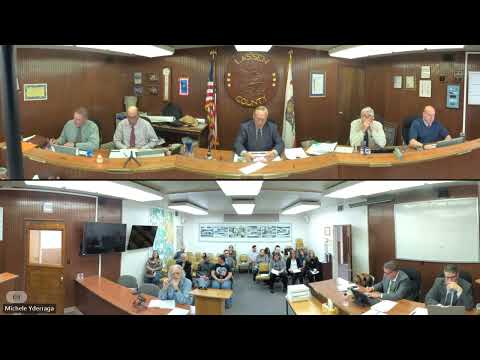
Lassen County Board classifies alpacas as large livestock after neighbor complaints
Summary
After neighbor testimony about odors, runoff and high stocking density, the Board voted to classify alpacas as large livestock under county code — a move that reduces permitted numbers per acre and will cut the permitted herd size on the parcel at issue.
The Lassen County Board of Supervisors voted to classify alpacas as large livestock, a change that reduces the number of alpacas allowed per acre and will immediately reduce permitted herd sizes on parcels countywide.
Associate planner Mindy Hilton asked the board to interpret county code to determine whether alpacas are defined as small or large livestock. Hilton said the county code currently allows seven small livestock per acre but only two large livestock per acre, and she noted that code chapter 18.108 (special provisions) lists llamas among large livestock. Hilton told the board that weight is only one factor in the classification; the department had considered impacts such as noise, odor and grazing behavior.
Neighbors who live beside the parcel at issue urged the Board to treat alpacas as large animals. “The smell is atrocious,” said Teresa Stalteri, who said animals were packed together and that piles of feces had been visible before code enforcement intervened. Victoria Hall, who described herself as an immediate neighbor with farming experience, said alpacas “are pretty loud” and that warming weather had increased odor. Joshua Carpenter, another adjacent resident, said he supported neighbors’ calls for relief.
Owner Heidi Pray said she did not expect the seller to place more than 80 animals on the property and that she is working to recover her parcel; she said she previously had about a dozen alpacas on the site. Those comments were noted by the Board but did not change speakers’ competing accounts of how many animals remained on site.
Supervisors discussed technical factors, including the animals’ dentition. One supervisor said top teeth allow closer grazing and greater environmental impact, likening alpacas to deer in terms of grazing ability. Board members said the decision was countywide and would remain in effect until the code was revisited.
Supervisor [motioning member] moved to classify alpacas as large livestock; the motion was seconded and the Board approved the determination in a roll‑call vote. The classification means the county’s stocking limits for alpacas will be enforced under the large‑livestock rate described in title 18 of the Lassen County Code.
The Board did not set a separate enforcement schedule in the hearing; staff said the classification will be applied per current code and that a future code revision could revisit numeric limits or counting rules. The matter of ongoing enforcement at the specific parcel was raised by residents but the Board’s action at the meeting was limited to classification, not a site‑specific enforcement order.
The Board moved on to other agenda items after the roll call.