Get Full Government Meeting Transcripts, Videos, & Alerts Forever!
Get email alerts on the Education Math Acceleration topic
No spam. Unsubscribe anytime.
Palos Verdes Peninsula Unified outlines double-acceleration math pathway for sixth-graders
Summary
A district presenter explained the double-acceleration option for Math 6 Accelerated students, describing eligibility criteria, assessment format and timeline, summer-school restrictions and the district's recommendation that families weigh readiness and long-term conceptual understanding before opting in.
A presenter for Palos Verdes Peninsula Unified described the district's "double acceleration" math pathway for sixth-grade students, explaining who qualifies, how the district's assessment works and the timeline families should expect.
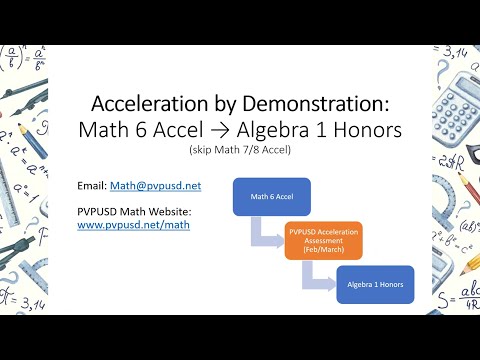
The presenter said double acceleration allows qualifying students to skip Math 7-8 Accelerated and progress to Algebra I Honors in seventh grade, then Geometry in eighth grade, continuing toward college-level calculus by their senior year. "It is about gaining a deeper understanding, not just about a higher number or course name on a report card," the presenter said.
Why it matters: the district framed the option as a tool to keep students who grasp concepts quickly engaged and challenged, while warning that accelerating an unready student can cause stress, burnout and loss of confidence. The presenter repeatedly emphasized that readiness should be assessed by skills and habits, not just grades.
Eligibility and assessment: the presenter said qualifying requires passing a district acceleration assessment administered during a student's Math 6 Accelerated year and meeting at least two of three criteria listed by the district: earning As in the current math class, meeting set criteria on a diagnostic assessment, or meeting criteria on a readiness assessment. "This is just one of the requirements to qualify for double acceleration," the presenter said.
About the test: the acceleration assessment covers seventh- and eighth-grade standards and is not multiple choice; students must show their work and explain their thinking. Study resources recommended on the district website include Khan Academy and Big Ideas Math. The presenter said families should expect results in about a month after testing.
Family decision and alternatives: the presenter emphasized that even when a student qualifies, "the final decision to accelerate is yours to make as a family." The district also offers multiple acceleration opportunities across pathways, so families may choose to wait a year if the student is not ready.
Summer-school limits and approvals: the presenter stated that "Algebra 1 is not allowed to be completed in summer school" and must be taken within PVP USD to ensure a consistent foundation. Students may take a maximum of one math course during summer; it must be preapproved by the school site and be UC- and WASC-accredited. If families opt for summer study, the presenter said geometry is the preferred course.
Timeline and registration: the presenter advised families to begin self-study and to look for a registration email from the district via ARIES Communications in January or February; the district math acceleration website will also post the registration link. The test will be administered in late February to early March, with results sent in March or early April.
The presentation closed with a reminder to prioritize students'mindset, persistence and overall readiness over simply progressing faster: "Thriving right where you are is better than surviving in a class that is a step too far," the presenter said. Families with additional questions were directed to math@pbpusd.net.