Get Full Government Meeting Transcripts, Videos, & Alerts Forever!
Get email alerts on the Public Works topic
No spam. Unsubscribe anytime.
Jurupa Valley public works reports higher service requests, lays out $120M streets need and CIP projects
Summary
Public works reported 4,014 closed service requests last fiscal year (up 985), a 7% increase in illegal-dumping responses, improved tree-maintenance response times, and rolled out a multi-project capital improvement program funded in part by ARPA and developer contributions, including major paving and signal upgrades.
City public-works staff reported fiscal-year performance data and outlined capital projects the city plans to deliver over the next months and years.
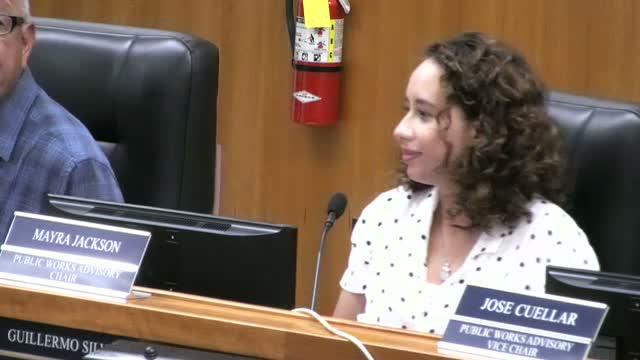
Vice Chair Jose Cuellar (first identified during roll call) presented service-delivery metrics: staff closed 4,014 service requests in the fiscal year, an increase of 985 requests from the previous year. Staff highlighted a 7% increase in illegal-dumping calls and said staff closes illegal-dumping requests in about 48 hours on average; pothole requests were reported at 16% of requests and are down 7% from the prior year. The presenter said tree-maintenance response time improved from roughly 31 days to 15 days after process changes.
Staff noted resources: the city has five in-house street-maintenance workers plus five contracted staff and said council approved two additional in-house maintenance positions for the coming fiscal year. Staff said their longer-term goal is to continue adding in-house capacity to reduce reliance on contractors.
Capital program highlights: a city official walked the committee through an interactive CIP map on the city website and listed completed and upcoming paving projects funded largely from ARPA funds. The presentation named work on Mission Street and Pacific Avenue, and included a targeted overlay program funded with roughly $5'$6 million for routine overlays; the official also estimated a total need to fully fix all streets at roughly $100'$120 million. Staff said two large projects were awarded and construction would start soon on portions of Mission Street and in the Paradise Knolls area. Developer mitigation funds (about $8 million) were cited to finance neighborhood improvements in Avalon/Belton, and CDBG funds were identified for overlays in Glenover/Ruby Dow.
Traffic and signals: staff described an early-phase assessment (PAED) for improvements at the State Route 60/Rubedo interchange to identify alternatives and coordinate with Caltrans for future design and funding. The presentation noted a planned traffic signal at Pyrite and Mission to serve a new shopping center and a separate federal/state-backed project to upgrade or interconnect approximately 96 signals across the city.
Facilities and timeline: staff said the city is planning an annex to the current city building (10,000'12,000 square feet) to add lobby and workspace and later renovate the existing building; architects have been engaged and staff gave an optimistic target to have plans and funding discussions complete in 6—2 months, with a longer-term, tentative target of three years for construction, contingent on funding.
What's next: staff said many CIP projects are moving toward advertisement for bid or are already awarded; for projects requiring federal or state funding (for example, signal upgrades or Caltrans-coordinated interchange work), the city will pursue approvals and grant opportunities prior to construction.