Get Full Government Meeting Transcripts, Videos, & Alerts Forever!
Get email alerts on the Land Use Development topic
No spam. Unsubscribe anytime.
Jurupa Valley planning panel recommends Rio Vista plan, citing expanded buffers and tribal conservation deal
Summary
The Planning Commission voted 4–1 to send the Rio Vista Specific Plan, EIR certification and related approvals to city council after the developer and a tribal steward agreed to wider buffers, interim protections and an MOA intended to conserve the Palmer Oak and nearby cultural sites.
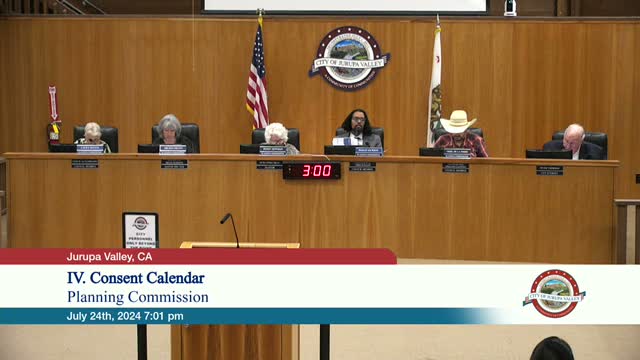
The Jurupa Valley Planning Commission voted 4–1 on July 24 to recommend that city council certify the Rio Vista environmental impact report and approve associated land‑use changes, a development agreement and tentative tract maps after staff and the applicant agreed to a set of conservation commitments for the Palmer Oak and surrounding open space. Chair Newman said the changes — including a no‑construction buffer and an MOA with a tribal steward — provide immediate protections that private land currently lacks.
Staff principal planner Jim Petches told the commission the project team expanded the no‑construction buffer around the Palmer Oak to 450 feet and set a 550‑foot setback to the closest building after reviewing hydrogeologic, biological and vibration studies. Petches said the developer also agreed to additional conditions including cool‑pavement requirements, enhanced landscaping and interim conservation measures to maintain the oak until a conservation entity is in place.
“We’ve expanded the buffer area to 450 feet as a no construction zone and 550 feet to the closest building,” Petches said, framing the changes as a response to commissioner concerns raised at prior hearings.
The developer and the Gabrielino/Keish tribal representatives told commissioners they had finalized a memorandum of agreement (MOA) that staff said will convey open‑space parcels and fund long‑term stewardship. Applicant representative Jeremy Kraut said the MOA language removes an earlier 30‑day administrative trigger and would be effective upon approval and recordation actions tied to the project.
“Those that was that particular provision of the 30 days is no longer in the agreement,” Kraut said, adding that the agreement ‘‘becomes immediate’’ on approval and contains voiding provisions if the project were rescinded.
The hearing included an extended technical presentation by the city and consultants describing multiple studies: a Stinson Engineering hydrogeologic investigation that found regional groundwater well below the surface and suggested the oak is sustained by localized rock‑outcrop water capture; a ground‑penetrating‑radar survey that detected subsurface water‑collection features; and a vibration analysis that set construction vibration standards intended to protect subsurface rock structures.
Opponents told the commission the EIR and related studies left key uncertainties unresolved. Environmental consultant Tim Krantz, who testified for members of the public, said the consultants’ short sampling window and redacted reports made it impossible to accept the conclusion that development would have an insignificant heat‑island impact.
“For the consultant to consider that this is insignificant, I think is shameful,” Krantz said, urging the commission to continue the hearing to allow independent review of the data.
Supporters — including trade unions, employers and several public‑interest groups — said the project promises jobs, infrastructure and housing. Labor representatives and industry speakers emphasized local hiring commitments and the economic impact of new industrial and business‑park space.
Tribal representatives who negotiated the MOA also spoke in favor of the agreement. Dr. John Torres, an archaeologist and tribal consultant, described the stewardship arrangement as a novel partnership of traditional ecological knowledge and contemporary science to manage and protect the site.
“I view it as an experiment, the sort of partnership that’s being created with the tribe and the developer,” Torres said.
On the final motion, commissioners directed staff to forward the certified EIR, a statement of overriding considerations, the general‑plan and specific‑plan amendments, the development agreement with revised park and equestrian language, and tentative tract maps to council; they excluded the applicant’s requested change to remove staff’s recommended single‑story requirement for certain lots. The motion passed 4–1, with Commissioner De La Torre voting no and expressing concerns about remaining uncertainties about root extent and long‑term groundwater connections.
The commission’s recommendation is advisory. The city council will take the final decision at a later hearing, where staff and the developer will present the record and the MOA will be part of the package the council reviews.
Votes at a glance: The Planning Commission moved, seconded and approved a resolution (PC‑2024‑15) recommending that city council: certify the EIR; adopt a statement of overriding considerations and a mitigation monitoring and reporting program; approve general‑plan and specific‑plan amendments; approve a development agreement with revised park/equestrian language; and approve two tentative tract maps. The motion passed 4–1 (yes: Newman, Pruitt, Jackson, Schultz; no: De La Torre).
What’s next: The commission’s recommendation and the EIR certification will be scheduled for Jurupa Valley City Council review. The MOA, the conservation conveyance steps and the conditions of approval described by staff will be examined and enforced — if council approves the project — through subsequent map recordation, development permits and the conservation entity’s formation.