Get Full Government Meeting Transcripts, Videos, & Alerts Forever!
Get email alerts on the Housing And Hud Funding topic
No spam. Unsubscribe anytime.
City presents FY25 HUD CAPER; public pushes smoke‑free policy and asks about homelessness services
Summary
City staff presented the FY25 Consolidated Annual Performance and Evaluation Report, summarizing roughly $39 million in HUD entitlement investments and outcomes. Public commenters urged smoke‑free requirements for HUD‑funded multi‑unit housing and pressed staff about service gaps and Homelessness Response Center operations.
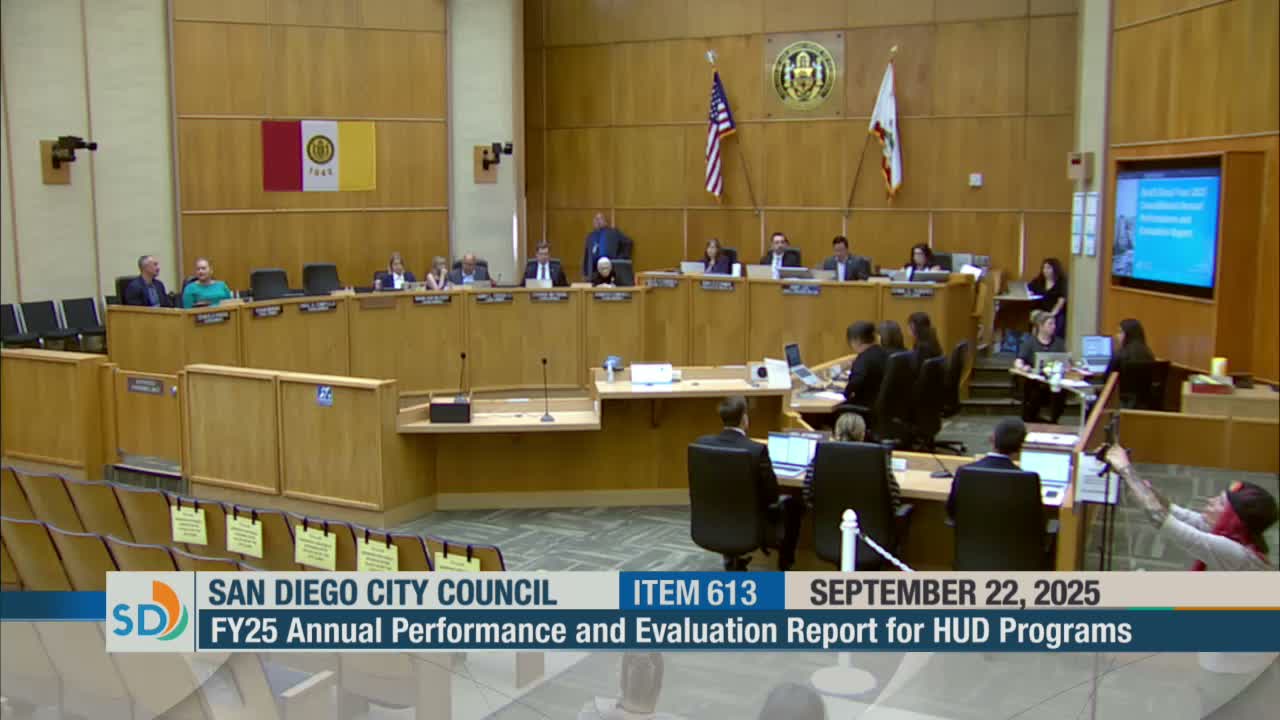
City staff presented the draft fiscal year 2025 Consolidated Annual Performance and Evaluation Report (CAPER) to the San Diego City Council on Sept. 22, summarizing how federal HUD entitlement grants were spent and what outcomes the city reported.
Melissa Villalpondo, community development coordinator in the Economic Development Department, said the city partnered with more than 60 nonprofits and invested "over $39,000,000 in federal HUD program funds" to support 125 unique projects in FY25. She listed program categories covered by the CAPER — Community Development Block Grant (CDBG), HOME Investment Partnerships (HOME), and Emergency Solutions Grants (ESG) — and said the report covers July 1, 2024 through June 30, 2025, the first year of the current five‑year consolidated plan.
Villalpondo highlighted examples: $2,000,000 in HOME funds supported construction of 15 units at Nestor Senior Village for low‑income households in Council District 8, and CDBG‑funded programs supported hundreds of small businesses and dozens of nonprofit facility improvements. Staff said HUD‑funded homelessness programs served more than 7,600 individuals and that overnight shelter operations served over 1,000 people during the year.
During the public comment period on the CAPER, multiple speakers praised HUD‑funded programming and urged the city to adopt a smoke‑free standard for HUD‑funded multi‑unit housing. Becky Rapp, a public health educator, said tying federal housing investments to smoke‑free policies would protect children, seniors and families from secondhand smoke and reduce fire risks. “By setting smoke free housing as a standard whenever city funds are invested, you protect children, seniors, and families from secondhand smoke,” Rapp said.
Councilmembers asked staff detailed questions. Councilmember Von Wilpert asked where the Homelessness Response Center was operating after a move; Christine Marcella, deputy director for Economic Development, said the program was being operated out of the Central Library while services continue at the Imperial Avenue site to meet CDBG requirements and to allow the pending Father Joe’s redevelopment to proceed. Angela Nazarino Clark, a program manager, confirmed the County administers the HOPWA program and that staff had not received guidance from HUD indicating changes to HOPWA’s administration during the consolidated plan year.
No formal council action was required — CAPER is an informational report — but staff said all public comments from the meeting and advisory board sessions would be incorporated into the final CAPER before the city submitted it to HUD on or before Sept. 28.
Councilmembers and staff repeatedly emphasized the CAPER’s role in demonstrating to HUD how federal entitlement funds were used and noted uncertainty in federal funding levels as a key risk for continued services.