Get Full Government Meeting Transcripts, Videos, & Alerts Forever!
Get email alerts on the Police Complaints topic
No spam. Unsubscribe anytime.
Carlsbad police outline complaint intake and investigation process; department reports 31 complaints last year
Summary
Assistant Chief Reid Shipley walked the commission through filing options, complaint classifications (Type 1 and Type 2), resolution categories and state decertification reporting. He said the department recorded 31 complaints last year with about 13% of externally generated complaints sustained.
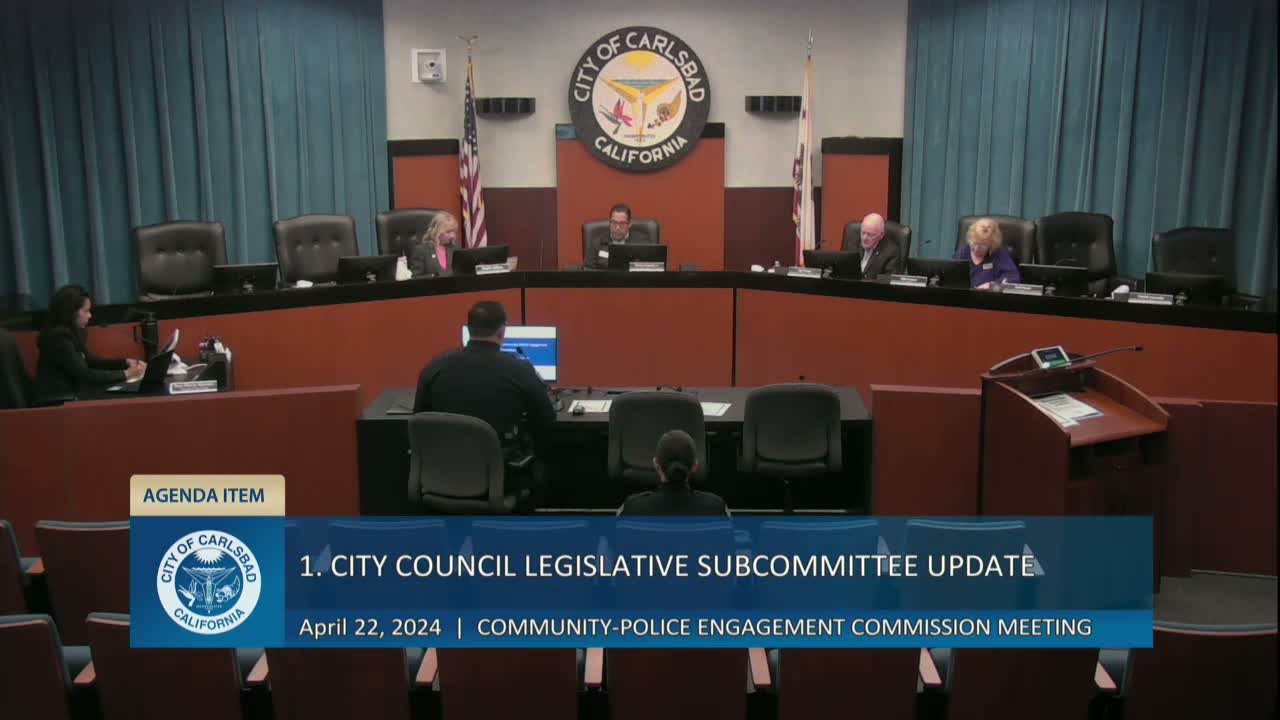
Assistant Chief Reid Shipley of the Carlsbad Police Department told the Community Police Engagement Commission on April 22 that residents can file complaints by phone, text, email, in person or via a fillable form on the department website.
Shipley said any member of the department is required to accept a complaint and that filings can be anonymous, although anonymity can hamper investigators seeking additional information. "The Carlsbad Police Department values community input, and we recognize that community trust is essential," Shipley said. He described the online form and noted it includes fields to flag profiling or bias concerns.
Shipley outlined the department's two-tier classification system. Type 1 complaints, he said, are lower-level matters typically resolved by a supervisor (documented counseling for first-time issues). Type 2 complaints involve more serious allegations and are investigated by the Professional Standards Bureau, with findings reviewed by a bureau commander and disciplinary determinations made by the assistant chief to ensure consistency. "If someone complains and if the complaint were true, we determine if the complaint were true, would it result in disciplinary action?" he said.
He summarized possible outcomes from an investigation: sustained, exonerated, not sustained, unfounded and withdrawn (when a complainant reviews body-worn camera footage and chooses to withdraw the complaint). Shipley said the department sends an initial acknowledgment letter upon intake and a letter within 30 days to notify complainants of the resolution and findings.
Shipley also described state reporting tied to decertification and the POST commission, saying certain categories of serious misconduct may trigger POST review beyond the department's internal process. "Decertification is run by the POST commission," he said.
On department statistics, Shipley reported: "We had 31 total complaints last year. 24 of those complaints were generated externally." He added that about 13% of externally generated complaints were sustained and that internal matters such as officer-involved shootings automatically generate internal reviews. Commissioners pressed for historical comparisons; Shipley said he did not have specific year-by-year numbers but attributed an increase in documented complaints in part to legislative changes that require formal documentation of interactions that previously might not have been recorded.
Commissioners also asked practical questions about access to the complaint form and intake process; Shipley displayed the fillable PDF and described how dispatch and supervisors handle phone reports and follow up by email when needed.
The presentation concluded with commissioners and staff thanking Shipley for the overview and inviting additional follow-up if the commission wanted more data or clarification.