Get Full Government Meeting Transcripts, Videos, & Alerts Forever!
Get email alerts on the Dredging And Nourishment topic
No spam. Unsubscribe anytime.
Carlsbad panel hears tri-annual update on shoreline work plan; staff outlines dredging schedule and regional project
Summary
City planning and parks staff told the Beach Preservation Commission on Aug. 6 that a planned nourishment project could place about 400,000 cubic yards of sand on local beaches, but permitting by multiple agencies means work likely would not start until late this year or early next year and must be finished by April 15.
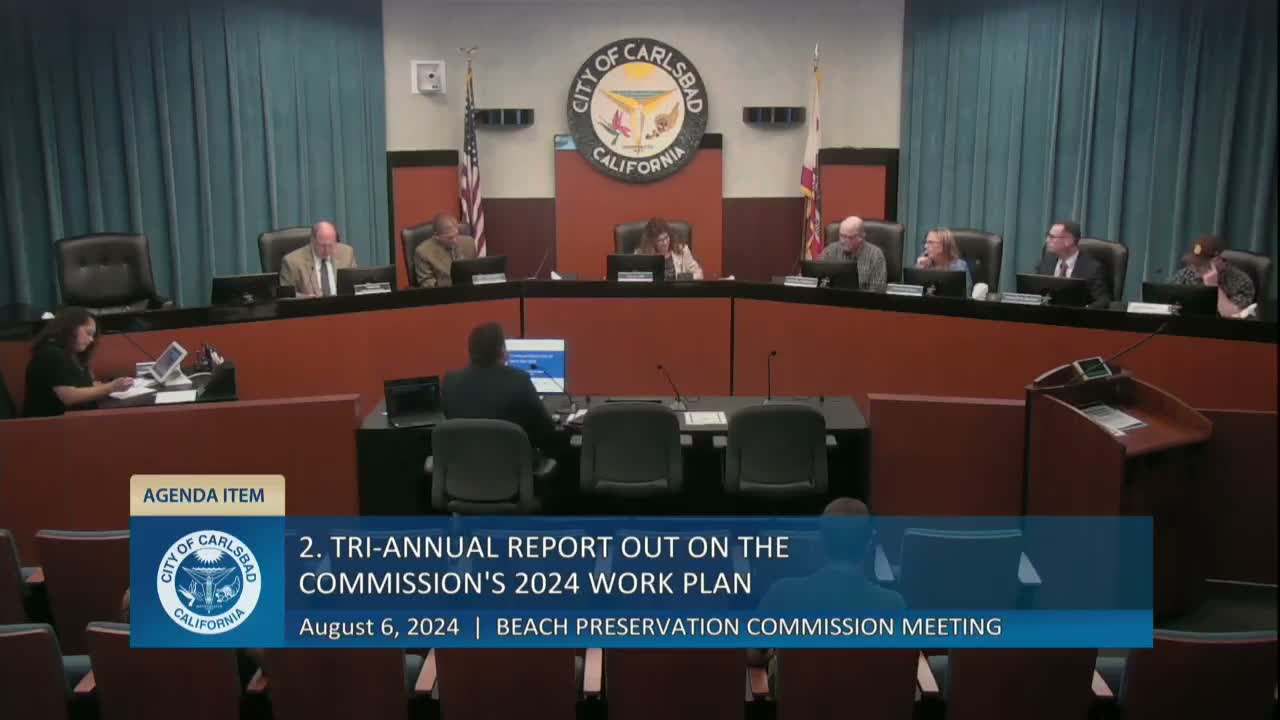
Carlsbad planning staff and Parks & Recreation department officials updated the Beach Preservation Commission on Aug. 6 about the commission’s 2024 work plan and regional nourishment projects, including permitting timelines and coordination with multiple agencies.
Planning manager Nick Stupin described the commission’s mission to advise the city council and city manager on erosion prevention, sea-level rise and related shoreline management. He said recent project planning includes an offshore dredge-and-deposit operation associated with Agua Hedionda that “will place approximately 400,000 cubic yards of sand on the local beachfront.”
Staff and commissioners discussed the permitting process. According to Parks & Recreation director Kyle Lancaster and planning staff, the project remains in permitting with the California Coastal Commission, the U.S. Army Corps of Engineers, California Department of Fish and Wildlife and other agencies. Lancaster said the city’s planning commission could see the permit application as early as December; if all agency permits are complete, work could start at the end of this year or in early 2025. “Their dredging operation is to be complete by April 15,” Lancaster said during the meeting.
Commissioners sought clarification about timing and which beaches would receive sand. Stupin said project details remain contingent on each permitting agency and that the 400,000-cubic-yard figure includes contingency allowances that could modestly increase the total deposit. He also described a separate, multi-city effort, Regional Beach Sand Project Number 3, administered by the San Diego Association of Governments (SANDAG), which remains in design and is expected to be two or more years from construction.
The presentation included a report on recent local outreach and volunteer efforts: the commission’s July 12 beach cleanup was attended by about 14 volunteers and staff reported roughly 100 pounds of trash collected, about 10 pounds of which were recyclable. Staff said they entered the cleanup data into the Clean Swell app to track progress and plan to add composting bins to future events to reduce landfill waste.
Commissioners asked how to add items to the annual work plan. Staff said adjustments are usually made once a year, with formal adoption in December and submission to the city council the following January. Commissioners requested a future agendized report that focuses on projects likely to affect Central and North Beach (for example, Agua Hedionda) and others more impactful to South Beach (for example, Batiquitos Lagoon dredging).
The commission recorded consensus that staff should continue pursuing agency coordination and return with updated permitting schedules and project-level detail. The commission also noted difficulties arranging presentations from State Parks staff and said they would continue to invite the agency to future meetings.