Get Full Government Meeting Transcripts, Videos, & Alerts Forever!
Get email alerts on the Budget topic
No spam. Unsubscribe anytime.
National City council accepts midyear budget adjustments, trims projected FY2025 deficit to about $3.3 million
Summary
The council voted to accept the FY2025 midyear budget report after staff recommended revenue increases and expenditure reductions — including ARPA reallocations and deferred CIP spending — which lower the projected deficit from earlier estimates to roughly $3.3 million. Council raised questions about staffing, pension projections and fire inspection fees.
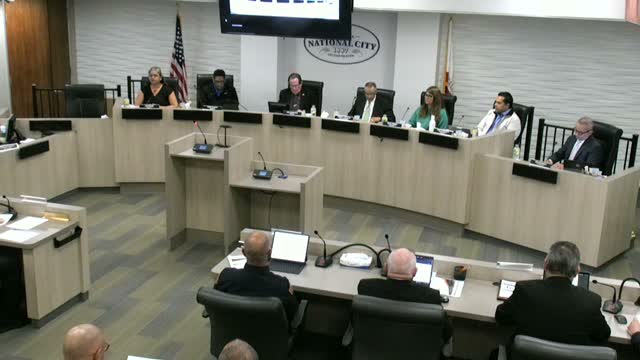
The National City City Council voted to accept the fiscal year 2025 midyear budget status report at a special meeting, approving staff adjustments that reduce the projected deficit to about $3.3 million.
Finance Director Bruce Fultz told the council that through the seven-month period (July–January) property and sales taxes make up roughly 79% of general fund revenues and that the city has received 52% of budgeted property tax to date. "We have received 52% of what we had budgeted for this year," Fultz said, describing revenue and expenditure patterns and the impact of vacancies and overtime on the budget.
The midyear package combines anticipated revenue increases — including state reimbursements for fire overtime, an expected $276,000 in additional property tax-related revenue and higher interest income — with expenditure reductions such as lower contract services, capital improvement project delays and use of ARPA funds. Fultz summarized staff recommendations as producing a net general fund improvement of about $1.1 million in additional revenues and just over $3.0 million in expenditure savings.
City Manager (unnamed in the transcript) framed the presentation as a realistic, conservative snapshot rather than a cause for alarm: "We're not in a panic mode," the manager said, thanking staff for preparing the midyear review and noting the organization remains "thinly staffed."
Council members pressed staff on several items. One member asked whether federal tariffs — particularly on vehicles — were reflected in sales tax projections. Fultz warned the impact is uncertain because higher prices can raise tax per sale while lower volume can offset it, and staff said they were not recommending a specific adjustment at this time.
Several council members probed the accounting treatment of so-called "savings" from deferred CIP projects, such as roughly $500,000 tied to a restroom project that will be built next fiscal year. Finance staff said the amounts are deferred expenditures (not permanent eliminations) and therefore show as savings for the current midyear snapshot.
ARPA reallocation drew pointed comment. Public commenter Ted Gottschalk said the ARPA funds "look like it's hijacked to me." Steve Manganiello, Director of Engineering and Public Works, responded that shifting about $1.5 million of projects to ARPA met a December 31, 2024 obligation deadline to obligate contracts for ARPA funds; "If we failed to do that, any money that was not obligated would have had to be returned to the U.S. Department of the Treasury," Manganiello said, and he reported that the highest-priority projects voted on by the community are funded and under construction.
Council members also raised staffing concerns after staff said many enhancement positions will remain unfilled this year to reduce spending. One council member noted the deficit improvement (from an earlier $7 million estimate down to $3.3 million) comes with the trade-off of continued lean staffing and flagged several unfilled positions including a management analyst and human resources manager.
Division Chief Robert Hernandez of the Fire Department clarified a listed decrease in "fire inspection service" revenue: inspections have not been curtailed, Hernandez said, but some inspections for smaller businesses are not currently captured by the California Health and Safety Code. Staff plan to return with an ordinance in April to formalize and capture those inspections so appropriate fees can be charged; Hernandez said the city continues to perform inspections and provide education to businesses.
At the meeting's close, Council Member (12) moved to accept the midyear budget report and Council Member (10) seconded; the motion passed (the transcript does not record a roll-call tally). The council then adjourned.