Get Full Government Meeting Transcripts, Videos, & Alerts Forever!
Get email alerts on the Behavioral Health topic
No spam. Unsubscribe anytime.
County behavioral health briefs Carlsbad commission on CARE Act voluntary court pathway
Summary
San Diego County behavioral-health staff described the CARE Act's court-initiated, voluntary treatment pathway for adults with qualifying psychotic disorders, the county's early enrollment numbers and how local petitioning and outreach work in practice.
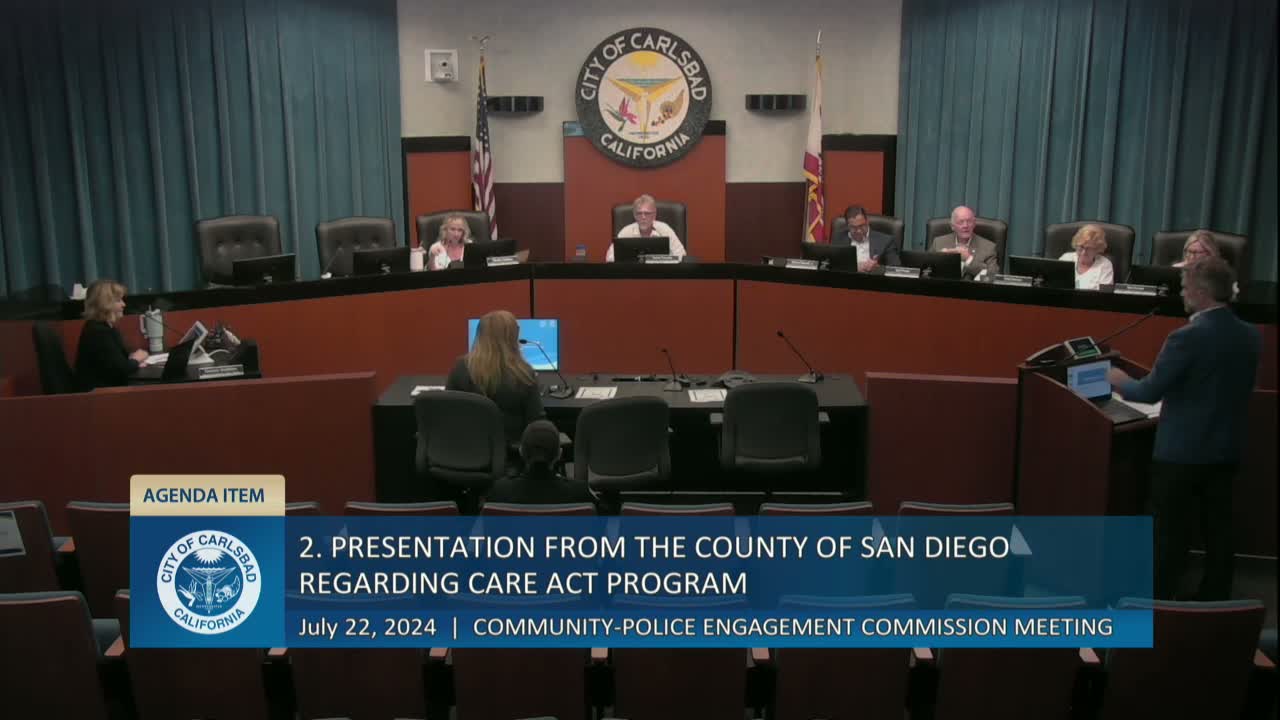
San Diego County Behavioral Health program manager Claude Winship told the Carlsbad Public Safety Commission that the CARE Act (Community Assistance, Recovery and Empowerment), signed in 2022, provides a court-supervised, voluntary path for adults with qualifying psychotic disorders to receive coordinated treatment and services.
"CARE Act is a voluntary program with court oversight," Winship said, stressing the program is not a mandate to force medication or treatment. He described qualifying diagnoses as schizophrenia, schizoaffective disorder, brief psychotic disorder, delusional disorder and other psychotic-spectrum disorders; he said major depression, bipolar disorder and substance use disorder alone do not qualify.
Winship explained the process begins with a civil petition filed at the courthouse by a qualified petitioner (family member, neighbor, first responder, provider or law enforcement). After the judge makes a prima facie finding the petition moves to county behavioral health for outreach; staff have roughly two weeks to engage the person, seek consent and develop a care agreement that sets individualized services for up to 12 months with status hearings every 60 days. If the person and treatment team agree, the care agreement may be renewed for an additional year.
The county reported about 139 petitions to date, of which roughly 45 resulted in entered care agreements; Winship said about 50% of petitions come from family members and roughly 8% were internal agency referrals. He emphasized outreach, relationship-building and a person-centered approach, noting many unhoused individuals require repeated contact before enrolling and that housing assistance is often a significant engagement tool.
Commissioners asked about court training, how CARE overlaps with behavioral-health diversion courts, funding longevity and whether CARE alters police authority. Winship said San Diego has a dedicated CARE judge (Paula Rosenstein) and a public defender experienced in behavioral-health court; CARE remains voluntary and does not extend police powers. He added the initial implementation funding is expected to last several years but may be affected by state budget conditions.
County staff urged commission members and community groups to use the county's petition form and the Access and Crisis Line for assistance with filings and to consult the county's web resources for more information.